

Matthieu Pavon's chip selection: 58, 52, or 9-iron
Around the green, which club should you use? Matthieu Pavon always follows the same principle: get the ball to land within the first few meters of the green. Depending on the distance to the flag and the roll needed, he switches from a 58-degree wedge to a 52-degree wedge and then to a 9-iron, using a technique similar to putting.
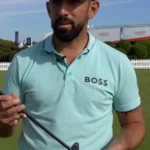
To be continued
What the lesson shows
According to Matthieu Pavon, It's where the ball is supposed to land that determines which club to use. He always visualizes the ball landing within the first few meters of the green. With the flag close by and little roll needed, he takes the most open club in his bag, the 58 Degrees. The flag is a little further away, about five meters farther: he hits a 52-degree wedge and lets the ball roll a bit. With about 25 yards left to go, he takes his 9-iron—which has a much tighter loft—to roll the ball to the flag.
Her tip for making chipping easier: draw inspiration from putting. The most important thing is good contact, to achieve the desired trajectory and spin. He checks to make sure his posture is correct and that his body is aligned with the target, then visualizes a large pendulum requiring as little manual adjustment as possible. He applies the same principles with his 8-iron: stance, shoulder alignment, and minimal wrist movement.
The Exercise, Step by Step
- Assess the situation: distance to the flag and the necessary roll.
- Imagine a ball falling within the first few meters of the green.
- Choose your club based on the roll: 58 degrees for a flag that's close by, 52 degrees for one that's a little farther away, and a 9-iron for a long roll.
- Stand up straight and make sure your alignment is in line with the target.
- Take a wide swing, just like when putting, while keeping wrist movement to a minimum.
- Keep the same landing spot and let the ball roll all the way to the flag.
Key Takeaways
Mistakes to Avoid
- Keep the same club regardless of the required roll.
- Aim for the flag rather than a landing spot on the green.
- Putting too many wrists in a chip.
- Ignoring posture and alignment on a short shot.
Driving Range Mode
Keep it in plain sight, on the rug.
- Three putts from different distances, played with a 58, a 52, and a 9-iron
- The same landing spot within the first few meters of the green for each club
- Chips in a putting motion, limited wrist movement
Your Questions
How does Matthieu Pavon choose which club to use for a chip shot?
He visualizes the ball landing within the first few meters of the green. That landing spot and the roll needed to reach the flag determine which club to use.
Which club should I use for a flag near the edge of the green?
The most open club in his bag—a 58-degree—since it doesn't need much roll.
When does he use a 9-iron?
When the ball has to roll a long way—for example, about 25 yards—he always drops it within the first few meters of the green and lets it roll.
What technique does he use to make his chips simpler?
When it comes to putting: good posture, alignment toward the target, and a long backswing with as little hand movement as possible. He applies the same principles to the 8-iron.
Learn More
Video posted on YouTube by its creator (Matthieu Pavon). Best Golf Tips selects and summarizes the best free lessons without hosting them.