

Forearms aligned with the fairway wood: consistent contact
Do your fairway woods fly high or skim the ground? Danny Maude starts by addressing what happens before the swing: the ball’s lie, the ball position, the distance to the ball with relaxed arms, and—most importantly—the alignment of the forearms. Only then does a fluid, effortless swing follow.
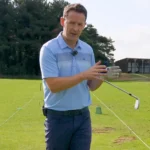
To be continued
What the lesson shows
As Danny Maude points out, fairway woods are the hardest clubs to hit from the fairway because they are the longest and the least open. Step 1: Examine the lees. If the ball is sitting a little deep, even a good swing will result in a topped shot or a thin shot; in that case, it’s better to use a hybrid with a fairly open face—a 5 or a 6—to make progress. Next, you need to strike the ball with a slight downward path: the lowest point of the swing arc is below the front shoulder, so The ball is placed just behind this point.
The distance from the ball determines the depth of the arc. If you lean in too far, with your arms bent, you’ll dig and scrape; if you stand too far back, with your arms extended toward the ball, you’ll top it. He leaves let your arms hang loosely and simply place the club on the grass. The key point is the’aligning the forearms with the clubface: For his student Eric, having his back forearm higher caused his swing to drift across the line, and the ball would veer to the right. He kept his biceps pressed against his chest to align his forearms, then did the “one and two” exercise to feel the clubhead swing.
The Exercise, Step by Step
- Before taking out your wood, check your lie: the clubface should be able to reach the bottom of the ball. If not, use a 5 or 6 hybrid and move the ball forward.
- Extend your arm forward and hold the club in a straight line, then let the club drop to the ground: the ball should be placed just behind that point.
- Let your arms hang loosely and rest the club on the ground, without pushing it in or holding it up. If the ball is above your feet, move your hands down the grip a little.
- Position the clubface square, then check your forearms: they should be at the same level and aligned with the clubface.
- To align them, gently press your biceps against your chest.
- Do the “one and two” exercise: smooth back-and-forth movements, lightly touching the ground.
- Position the club in front of the ball, then behind it to check your stance, and swing with the same relaxed motion.
Key Takeaways
Mistakes to Avoid
- Hit a fairway wood off a buried ball.
- Try to help the ball rise instead of hitting it on a slight downward path.
- Leaning too far forward, arms bent: when extending, the club digs in and you hit fat shots.
- Standing too far back, with your arms extended toward the ball: at impact, you’ll either hit the ball thin or get a thin shot.
- A back forearm that is higher than the front forearm, which directs the swing across the line.
- Compensating with your wrists, which compromises contact.
Driving Range Mode
Keep it in plain sight, on the rug.
- Check the lie before each wood shot
- Place the club in front of and then behind the ball to set up your stance
- Biceps against the chest, forearms aligned
- “One and two” swings that touch the ground before making contact
Your Questions
What should you do if the ball is slightly embedded in the fairway?
Danny Maude advises leaving the fairway wood in the bag. Hitting it on a steep downward path to get it out reduces the loft and requires a lot of speed. He recommends a fairly open hybrid—a 5 or a 6—to drive the ball forward.
How can I tell if my forearms are misaligned?
At address, compare their heights: if the back forearm is significantly higher, your arms are pointing across the line. His student’s clubface was square, but the swing crossed the ball and veered to the right.
Where should you place the ball when using a fairway wood with this method?
Extend your front arm and keep the club in a straight line, then let the club drop: this is the lowest point of the swing, below your front shoulder. Position the ball just behind this point so that the club strikes the ball and then the ground.
What is the purpose of the “one and two” exercise?
Feel the clubhead swing once you're in position. Make smooth back-and-forth swings, lightly touching the ground, then swing through with the same feel, without forcing it.
Learn More
Video posted on YouTube by its creator (Danny Maude). Best Golf Tips selects and summarizes the best free lessons without hosting them.