

Flighted Wedges from Scheffler, Morikawa and Korda
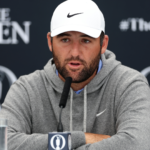
Do pros try to get as much spin as possible on their wedges? Quite the opposite, says Scottie Scheffler. Together with Collin Morikawa and Nelly Korda, he demonstrates how to hit a “lofted,” low, and controlled wedge shot—and explains why a full wedge shot remains the exception.
To be continued
What the lesson shows
For Collin Morikawa, a grooved wedge takes off with a lower launch angle and stays downwind; he plays it this way all the time, not just when facing the wind, because the spin is more consistent and the speed control is better. Scheffler thinks first about what the ball will do on the green—that is, the spin: contrary to popular belief, he often tries to to reduce the effect. With 106 yards to go and the wind blowing against him, he leaves his 56° wedge—which would fly higher and curve more—on the ground and uses a 50° wedge instead.
The technique, according to Morikawa: a longer club and a smoother swing, because speed creates the effect; ball set back slightly, hands forward, stay ahead of the ball. Nelly Korda rarely hits it straight: she takes one club longer, aims at a specific target behind the flag, and plays a slight draw. When aiming at a flag in the front of the green on a firm surface, however, a solid wedge shot creates the spin that brings the ball back. When it comes to shaping the ball, all three talk about the feel in their hands and playing it safe: under pressure, each sticks to their go-to shot.
The Exercise, Step by Step
- Before choosing a club, ask yourself what you want the ball to do on the green.
- For a low, controlled shot, use a club one size larger than you would for a full wedge shot.
- Shorten your grip a little and position the ball slightly back.
- Keep your hands forward and stay in front of the ball throughout the entire motion.
- Swing more gently, without trying to speed up at impact.
- Choose a specific target (Nelly Korda is aiming for three trees behind the flag) and go for it.
- Aim for a flag at the front of a firm green, then switch back to a full wedge to bring the ball back.
Key Takeaways
Mistakes to Avoid
- Believing that you should always hit a wedge with as much spin as possible.
- Hitting a wedge squarely into the wind: the ball rises too high and spins too much.
- Playing too aggressively toward a flag protected by a bunker.
- Forget about the slope beneath your feet: if the ball is lower than your feet, you need to move closer to it.
- To be able to move the ball in both directions under pressure.
Driving Range Mode
Keep it in plain sight, on the rug.
- Same target at 100 yards: a full wedge, then one club longer with a smooth swing
- Note the height and the ball's bounce on the green
- Practice your distances at the driving range to figure out your “110-yard shot”
- A series of shots toward a flag at the front using a full wedge, then toward the back with a high-trajectory shot
Your Questions
Why is Scheffler trying to reduce the spin on his wedges?
First, he thinks about how the ball will behave on the green. A wedge hit squarely rises higher and curves more; with a longer club hit more softly, the ball flies lower, and he doesn't have to worry as much about the wind.
How does Morikawa lower the trajectory?
He uses a longer club and swings more slowly, because speed creates spin. The ball is positioned slightly back, his hands are forward, and he stays ahead of the ball at impact.
When should you still hit a full wedge shot?
When aiming at a flag near the front of the green—especially on a firm green—hitting the wedge squarely causes the ball to roll back. When aiming at a flag at the back of the green, one of the players points out that he would need a 9-iron to hit it squarely; otherwise, the ball rolls back too far.
What target does Nelly Korda aim for on this type of shot?
A very precise shot behind the flag—in this case, three trees. She doesn't even look at the flag anymore and plays a slight draw, letting the slope carry the ball back.
Learn More
Video posted on YouTube by its creator (Scottie Scheffler). Best Golf Tips selects and summarizes the best free lessons without hosting them.