

Complete the backswing: move your body out of the way of your arm
A great shot, then a disaster; little effort when it works, less distance when you force it. For Edouard Montaz of Wisdomingolf, the answer often lies at the top of the swing: an incomplete backswing.
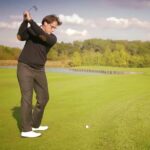
To be continued
What the lesson shows
Edouard Montaz builds each shot from the end to the beginning: the target, the trajectory, the setup, and then the backswing. He questions backswings where the lower body moves very little and the shoulders rotate against resistance, which he considers contrary to anatomy. His analogy: a sword cutting through a bamboo stalk. To achieve a full range of motion without getting injured, the body must move out of the way, and speed follows the sequence floor, hips, torso, arms, club. He cites Ben Hogan, Bobby Jones, Jack Nicklaus, Moe Norman, Lee Trevino, and Tom Watson as his role models.
The exercise: in position, let the weight of your left arm hang down. If the body doesn’t move, the arm hits it; the body then reacts and gets out of the way, staying centered with the weight over the middle of the feet. Depending on the player, the left ankle rolls inward or the left heel lifts, as with Phil Mickelson. Once the backswing is complete, you shift your weight onto your left foot and relax. On the course, the final thought isn’t the backswing but a whip toward the target, the club that mows the grass.
The Exercise, Step by Step
- Stand facing a partner and let your arm hang down; it should rest against your body.
- Get into your posture, leaning from the hips, and let your left arm drop: feel where it would hit your body.
- Let your hips and chest rotate so he doesn't hit you, while staying centered.
- Start again with a club and lift it until you can't go any further, with your left knee turned inward and your left heel free if necessary.
- Keep your eyes on the ball; your head may turn slightly.
- Brace yourself on your left foot and swing the club toward the target, as if you were mowing the lawn.
Key Takeaways
Mistakes to Avoid
- Keep your hips still and rotate your shoulders against resistance.
- Move only your arm: limited range of motion and a lot of fatigue.
- Shift your weight instead of staying centered.
- Focus only on completing the backswing on the course, without aiming at the target.
Driving Range Mode
Keep it in plain sight, on the rug.
- "Falling Arm" Exercise, First Without a Club, Then With a Club
- Full swings (“full backswing, full release”) toward an intermediate point
- Control: being able to repeat the movement in the morning, at noon, and in the evening without getting tired
- Cut the grass toward the target with every swing
Your Questions
How do I know when my backswing is complete?
For Edouard Montaz, this is when your body has completely moved out of the way of your left arm and you can't go any further. The test: feeling like you could swing the club effortlessly, shot after shot.
Can the left heel lift off the ground?
Yes. Depending on the player, the left ankle may roll inward or the left heel may lift. It's not a problem as long as you stay centered.
Why not turn your shoulders toward your hips?
According to him, this grip does not take the body’s anatomy into account and requires too much energy from the amateur golfer. He prefers the examples set by Ben Hogan, Jack Nicklaus, or Tom Watson.
What should you keep in mind at the top of your swing?
Not during the backswing: with a whipping motion toward the target, the club cuts through the grass in the desired direction.
Learn More
Video posted on YouTube by its creator (Edouard Montaz). Best Golf Tips selects and summarizes the best free lessons, without hosting them.