

Matthieu Pavon's Controlled Draw: Clubface Toward the Ground
Matthieu Pavon naturally hits a fade. But some holes force him to make the ball curve from right to left. At the FFGolf driving range, he demonstrates the tight draw he’s developed with his coach, and how he’s been practicing it—fifteen minutes a day.
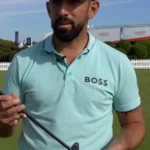
To be continued
What the lesson shows
For the draw, Pavon takes the reverse of his fade address: closed stance and shoulders, and a clubface that doesn't follow the shoulders—it's fairly neutral. He moves the ball back slightly In the stance: he makes contact a little earlier, and the ball flies farther to the right. His personal feel: the backswing is the same as for his fade—neutral or even slightly outside, with his hands high. But instead of keeping the clubhead pointed toward the sky as he does for the fade, he lets his arms and face drop toward the ground upon impact. The ball goes to the right and comes back.
When he was younger, he used to play a draw shot with a lot of hands and a very inside club: the curve was hard to control. Today, he achieves a tighter draw, with a curve of 13 to 16 feet, with less variation. His training method: exaggerate the curve Start with the first few shots to get a feel for the motion, then gradually reduce the swing. He uses the posts as targets: sending the ball to the right and bringing it back in, or sending it inside and keeping it there. The divot is thinner and longer than with a fade.
The Exercise, Step by Step
- Close your stance and shoulders relative to the target.
- Keep your face neutral, without letting it follow the movement of your shoulders.
- Move the ball back slightly in your stance.
- Take your stance as you would for your usual shot, with your hands high.
- On the downswing, let your arms drop and point the clubface toward the ground at impact.
- Start by hitting very curved draws, then reduce the curve with each shot.
- Aim for a post: hit the ball to the right and bring it back toward it.
Key Takeaways
Mistakes to Avoid
- Play for the draw with a wide range of hands.
- Bring the club all the way in: the ball starts to curve out of control.
- Let the face follow the closed shoulders.
- Keep the clubhead pointing toward the sky, as you would for a fade.
- Practice your draw for hours at a time rather than in short, focused sessions.
Driving Range Mode
Keep it in plain sight, on the rug.
- 15-minute sessions each day dedicated to drawing
- First pitches with a deliberately exaggerated curve
- Gradual reduction leading up to a tight draw
- Pole Drill: Go out to the right and come back in; go out to the inside and stay on the inside
Your Questions
How does Matthieu Pavon set up for a draw?
He adopts the opposite fade of his usual one: a closed stance and closed shoulders, a fairly neutral facial expression, and the ball positioned slightly back in his stance so that the shot goes more to the right.
What does “face down” mean?
For a fade, Pavon keeps the clubface pointing skyward. For a draw, he drops his arms and the clubface points toward the ground at impact: the ball goes to the right and then curves back.
What growth curve should we aim for?
For him, it's quite a personal matter. He practices by exaggerating the curve at first, then gradually reducing it until he achieves a tight draw, around 13 to 16 feet.
How did he prepare for this move before a tournament?
For three weeks, in 15-minute sessions each day, staying focused and aiming at poles to adjust the ball's trajectory as it leaves and returns.
Learn More
Video posted on YouTube by its creator (Matthieu Pavon). Best Golf Tips selects and summarizes the best free lessons without hosting them.