

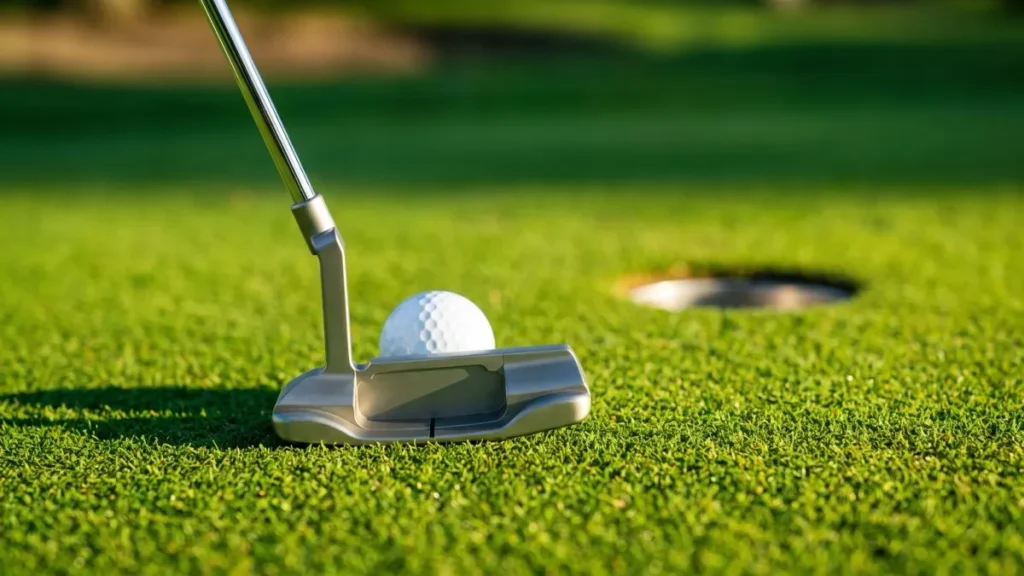
The putter is the club you take out of your bag most often, and yet it’s often the one you choose the fastest. Blade or mallet, length, loft, grip—a putter tailored to your swing makes your putts more consistent. Here’s how to choose one, how to grip it, and the mistakes that cost you the most strokes on the green.
What is a golf putter?
The putter is the club designed to roll the ball across the green toward the hole. Its face is nearly vertical: golf rules define it as a club with a loft of no more than 10 degrees. It is not used to hit the ball high into the air, but to roll it along a straight line at the right speed.
It’s also the most personal club in the bag. There’s no such thing as a “good” putter in absolute terms—there’s only the putter that suits your stroke, your height, and your stance. The basics of the stroke are covered on our page dedicated to the Putting.
Blade or mallet: Which putter head should you choose?
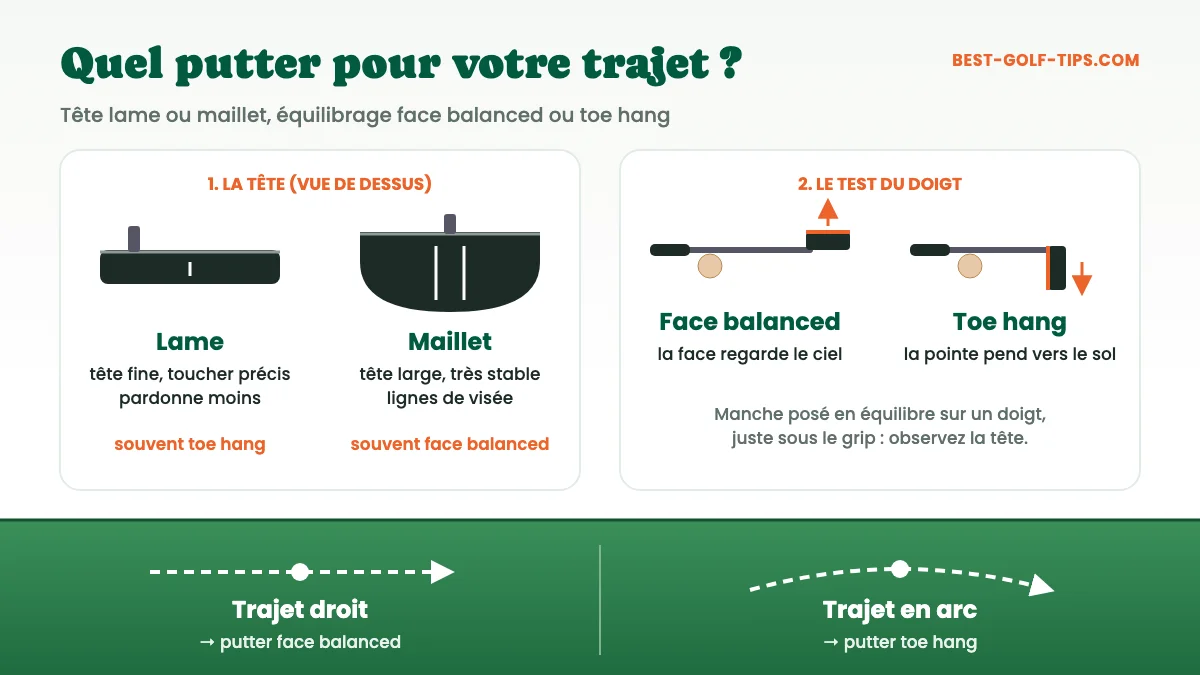
| Putter Type | Features | Most Common Balancing Method | For which route? |
|---|---|---|---|
| Blade | Slim, compact head; great feel | Toe hang | Arc swing: the clubface opens and then closes |
| Blade with weighted heel and tip | More forgiving blade, weight distributed to the tips | Slight toe hang | Light bow |
| Mallet | Wide, deep head; very stable; line of sight | Face-balanced | Straight swing path; the clubface remains square |
The blade: the classic head
The blade is a narrow head, often with a bent neck. It offers precise control and a good feel for the face. On the other hand, it is less forgiving: a putt struck toward the toe or heel loses more speed than with a mallet.
The mallet: the head that forgives
The mallet has a larger head, either half-moon-shaped or in a more modern design. Its weight is distributed away from the face, making it more stable when the ball isn’t struck in the center. It often features long lines that help with alignment. Many amateur golfers find that this improves their consistency on short putts.
Face-balanced or toe-hang: the finger test
Balance the putter shaft on one finger, just below the grip, and let the head hang down. If the face is pointing toward the sky, the putter is face-balanced. If the tip points toward the floor, it is toe hang. Anything in between is called a partial toe hang.
- Straight path, from back to front, with the face remaining square: a face-balanced putter makes the most sense.
- Arc Path, the head rises slightly inside the swing and then comes back: a toe-hang putter better accommodates the natural opening and closing of the clubface.
To figure out your path, place a stick on the ground and film yourself from the front or the back. The choice of which angle to use comes later, not before.
What putter length should you choose based on your height?
Most putters on the market measure between 33 and 35 inches, or about 84 to 89 cm. Size is a good starting point, but your stance is what really matters.
- Less than 1.60 m: 32 to 33 inches (81 to 84 cm).
- From 1.60 to 1.75 m: 33 to 34 inches (84 to 86 cm).
- From 1.75 to 1.85 m: 34 to 35 inches (86 to 89 cm).
- Over 1.85 m: 35 to 36 inches (89 to 91 cm).
The proper test is done at the following address: bend forward from the hips with your arms relaxed; your eyes should be directly over the ball or very slightly inside it, and your hands should be directly under your shoulders. If you have to lower your hands on the grip, the putter is too long; if you’re bent over double, it’s too short. A test in the store or a fitting allows you to adjust this setting to the nearest centimeter.
The putter's loft: What is it for?
Even a putter has a little loft, usually between 2 and 4 degrees. This small angle lifts the ball out of the slight indentation where it rests on the grass, so that it starts rolling quickly without bouncing.
Actual loft also depends on your hands. If they’re ahead of the ball at impact, the loft decreases; if they’re behind it, the loft increases. That’s why a putter that works for one player doesn’t necessarily work for another. If your putts bounce off the ground or dig into it, the loft is the first thing to check.
How should you hold your putter?
There is no required grip for putting. The only restriction comes from the rules: since 2016, it has been prohibited to anchor the putter against the body—for example, with the grip resting on the stomach or chest; a long putter is still permitted as long as it is not anchored. Here are the three most common grips.
The Classic Grip
The left hand on top, the right hand underneath (for a right-hander). Most often, the left index finger covers the fingers of the right hand: this is the “reverse overlap” grip. Both thumbs rest flat on top of the grip. This is the most natural grip for beginners, as detailed in the full lesson at Paige Spiranac on putting.
The low left hand
Switch the hands: right hand on top, left hand underneath. This makes it easier to keep your shoulders level, and your left wrist stays more stable. Nelly Korda In her lesson, she explains why she uses this grip—with her fingers interlaced—and the feeling she’s aiming for: putting with her chest, not with her hands.
The claw
The left hand holds the grip normally, but the right hand does not wrap around it: the grip rests between the fingers, like a pencil. This makes it almost impossible for the right hand to rotate the clubface. Tommy Fleetwood says he adopted it because the ball's path was good, but the face was rotating too much from one putt to the next.
Common Mistakes with the Putter
- Choosing a putter based on its appearance. A good blade isn't suitable for a straight cut. First, test the cut, then test it with your finger.
- Keep the original length without checking it. A putter that's too long shifts your eyes inside the line and causes you to pull your putts. Check your address posture.
- Having a strong grip on the handle. Tense hands interfere with your touch. Hold the putter firmly enough to keep the face stable, but without tension in your forearms.
- Move your wrists. The swing starts from the shoulders; the wrists follow. If a wrist snaps at impact, it changes the loft and the direction.
Video Lessons to Improve Your Putting
 Learning to Putt: From Grip to Speed ControlPaige Spiranac · 20 min
 Tommy Fleetwood's Grip Claw: A More Stable FaceTommy Fleetwood · 2 min
 Low-handed left-handed putter: Nelly Korda's gripNelly Korda · 4 min
 Ball Position and Speed Control in PuttingJean Van de Velde · 6 min
For a complete guide, follow the free program Putt Better in 7 Steps, or browse all video lessons on putting.
Before you reach the green, you still need to start off on the right foot: make sure you position it at the right height The tee, depending on the club.
Frequently Asked Questions About Putters
What is the standard length of a putter?
Most putters measure between 33 and 35 inches, or about 84 to 89 cm. The right length is one that positions your eyes above the ball with your arms relaxed, without having to move your hands down the grip.
Mallet or blade: Which one should you choose when you're just starting out?
A putter with a mallet head is often easier to use at first: it’s stable, and its lines help you align your stroke. The most important thing is to adjust the putter’s balance to match your stroke path, whether it’s straight or arced.
Can you anchor your putter against your body?
No. Since 2016, the rules have prohibited anchoring the club against the body during the stroke. Long putters are still allowed, provided they are not pressed against the stomach or chest.
What loft should a putter have?
Most putters have a loft angle of between 2 and 4 degrees. The rules set a maximum of 10 degrees. The actual loft angle at impact also depends on the position of your hands.