

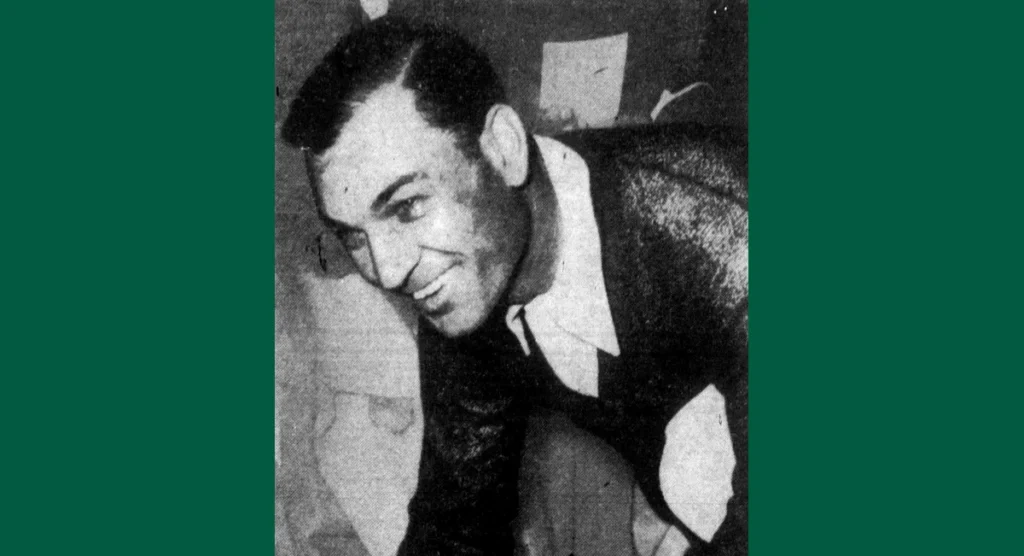
Nine majors, 64 PGA Tour victories, and a comeback to the top after a serious accident: Ben Hogan developed the most studied swing in history through relentless practice on the driving range.
Ben Hogan (1912–1997) won nine major championships—including three in a single season in 1953—and 64 PGA Tour events. His book Five Lessons It remains the best-selling golf instruction book of all time. Here is his biography, his record and the key points of his swing.
Who is Ben Hogan?
Ben Hogan was an American golfer, born on August 13, 1912, in Stephenville, Texas, and died on July 25, 1997, in Fort Worth. He turned professional in 1930 at the age of 17. His early career was difficult: for years, he struggled with a hook that he traced back to his days as a caddie, when he was trying to hit the ball farther.
He then established himself as the best player of his era: 13 wins on the PGA Tour in 1946 and 10 in 1948. He is the only player to have had more than one season with at least ten wins (PGA Tour).
In February 1949, a serious car accident sidelined him for the rest of the season and left him with lasting damage to his legs. Sixteen months later, however, he won the 1950 U.S. Open at Merion in a playoff: it was the “Miracle of Merion” (ESPN). After that, he only played a limited schedule.
In 1953, he won all three majors in which he competed: the Masters, the U.S. Open, and the Open Championship at Carnoustie—his only appearance in that tournament. He was unable to play in the PGA Championship, which was held the same week as the Open (Wikipedia). New York welcomed him with a parade. In 1957, he published Five Lessons: The Modern Fundamentals of Golf, co-written with Herbert Warren Wind.
Ben Hogan's Record
Ben Hogan won all four modern majors. Eight of his nine titles came in eleven appearances between 1948 and 1953.
| Major Tournament | Wins | Years |
|---|---|---|
| Masters | 2 | 1951, 1953 |
| US Open | 4 | 1948, 1950, 1951, 1953 |
| Open Championship | 1 | 1953 (Carnoustie) |
| PGA Championship | 2 | 1946, 1948 |
| Total | 9 | From 1946 to 1953 |
| Other Records and Honors | Result |
|---|---|
| PGA Tour Victories | 64 (4th all-time), 69 career wins total |
| PGA Tour Player of the Year | 4 times: 1948, 1950, 1951, 1953 |
| Vardon Trophy (lowest scoring average) | 1940, 1941, 1948 |
| Ryder Cup | Player-captain in 1947, captain in 1949 and 1967 (three U.S. victories) |
| Run in the majors | 8 majors won in 11 starts, from the 1948 PGA Championship to the 1953 Open Championship |
| Colonial (Fort Worth) | 5 wins, a record |
| Consistency | 14 consecutive top-10 finishes at the Masters (1939–1956) |
Sources: Wikipedia, PGA Tour, ESPN.
Ben Hogan's Swing: Key Points
Ben Hogan developed his swing on his own, on the driving range, to get rid of his hook. His book Five Lessons (1957) describes the fundamentals, which are still taught today.
- A Weaker Grip to Cure the Hook: Early in his career, a strong lead-hand grip and limited rotation gave him a hook. On Henry Picard's advice, he weakened his grip, one of the keys to his 'secret'. (GOLF.com)
- The 'Pane of Glass' Swing Plane: In Five Lessons, he imagines a pane of glass resting on his shoulders and tilted down toward the ball: the swing stays beneath that pane of glass. (GOLF.com)
- The “secret” of 1955: Revealed in Life magazine in 1955: a weaker grip, the clubface fanning open in the backswing and the lead wrist cupped at the top, to stop the hook. Hogan warned it would not help golfers who slice. (Wikipedia)
- Supination at impact: His lead wrist, cupped at the top of the swing, becomes bowed and supinated at impact. (GOLF.com)
- A consistent ball position: For his regular shots, he always placed the ball in the same spot, near his left heel: it was his stance that changed, not the ball. (Australian Golf Digest)
- Practice: He spent hours on the range and is often credited with 'inventing practice'. His most famous line: the secret is 'in the dirt', in other words on the range. (GOLF.com)
What Amateurs Can Copy from Ben Hogan's Swing
- Fix a hook with your grip first, but only if you hook: a weaker grip and an opening clubface were his anti-hook cure. He warned slicers it would make their fault worse. See our lessons on fixing a hook.
- Try his "two belts" exercise (1943): one belt around the arms, above the elbows, and another around the legs, above the knees, followed by smooth swings for a compact, connected movement. See our body rotation lessons.
- Keep your arms close to your body at impact and stay “under the glass” for a more compact and consistent swing. See our swing plane lessons.
Compare with other pros' swings.
Ben Hogan on Best Golf Tips
Best Golf Tips doesn't offer any video lessons by Ben Hogan, but his principles are at the heart of many topics: Grip, Swing and Swing Plane, Hook and Range Practice.
To read more, check out our ranking of the the greatest golfers of all time and the profiles of Jack Nicklaus, Gary Player and Collin Morikawa, often compared to Hogan for his iron play.
Ben Hogan FAQ: Majors, Secret, Swing and Five Lessons
How many majors did Ben Hogan win?
Nine: two Masters (1951, 1953), four U.S. Opens (1948, 1950, 1951, 1953), one Open Championship (1953), and two PGA Championships (1946, 1948).
What was Ben Hogan's secret?
Revealed in Life magazine in 1955: a weaker grip, the clubface opening in the backswing and the lead wrist cupped at the top, to eliminate his hook. For him, the real key remained practice on the range.
What is Ben Hogan's book Five Lessons?
His 1957 instruction book, written with Herbert Warren Wind and illustrated by Anthony Ravielli, first serialized in Sports Illustrated. It covers the grip, stance, posture and the two parts of the swing, and is still in print.
What is the 1953 “Hogan Slam”?
In 1953, Ben Hogan won the Masters, the U.S. Open, and the Open Championship at Carnoustie—the three majors in which he competed. He was unable to play in the PGA Championship, which was held the same week as the Open.
How many tournaments did Ben Hogan win on the PGA Tour?
64, which ranks him fourth all-time, and 69 career professional wins in total.