

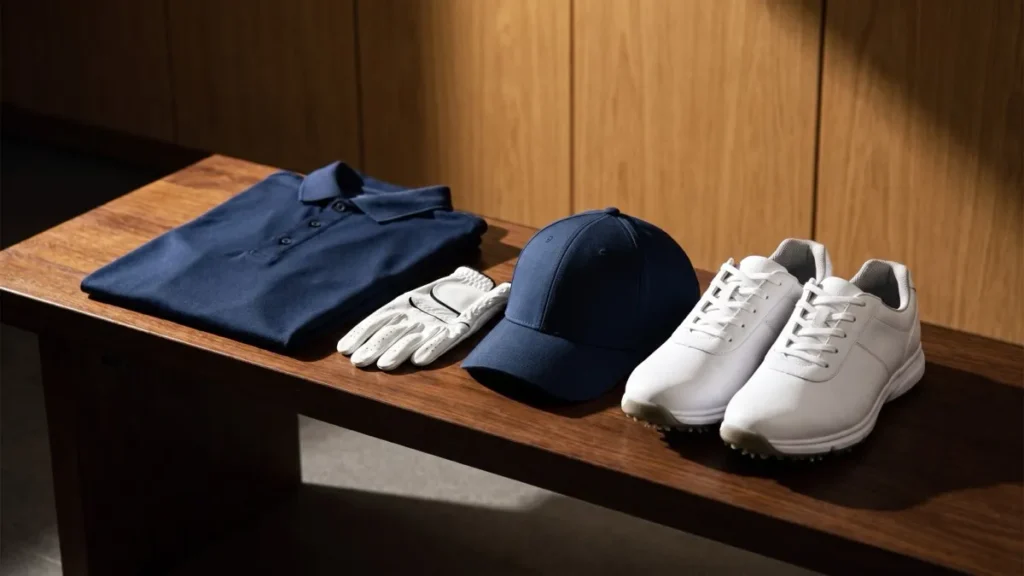
Before your first round, one question always comes up: What should you wear to play golf? There’s no official uniform, but most clubs expect you to dress neatly and wear appropriate shoes. Here’s what’s generally required, what’s often not allowed, how to dress for different weather conditions, and the accompanying rules of etiquette.
Why is golf attire required?
Golf has a tradition of proper attire, which is linked to its label: a set of rules governing courtesy and respect for the course. Attire is part of this spirit, just as silence while a playing partner is taking a shot is. There are also practical reasons: appropriate shoes protect the greens, and loose-fitting clothing allows for a free swing.
Key point: There is no single rule.. Each club sets its own rules and regulations, which are often posted at the front desk or at the clubhouse, or posted on its website. Public golf courses and driving ranges are generally more flexible than private clubs. If in doubt, call the front desk before you come.
What to Wear for Golf? The Typical Outfit
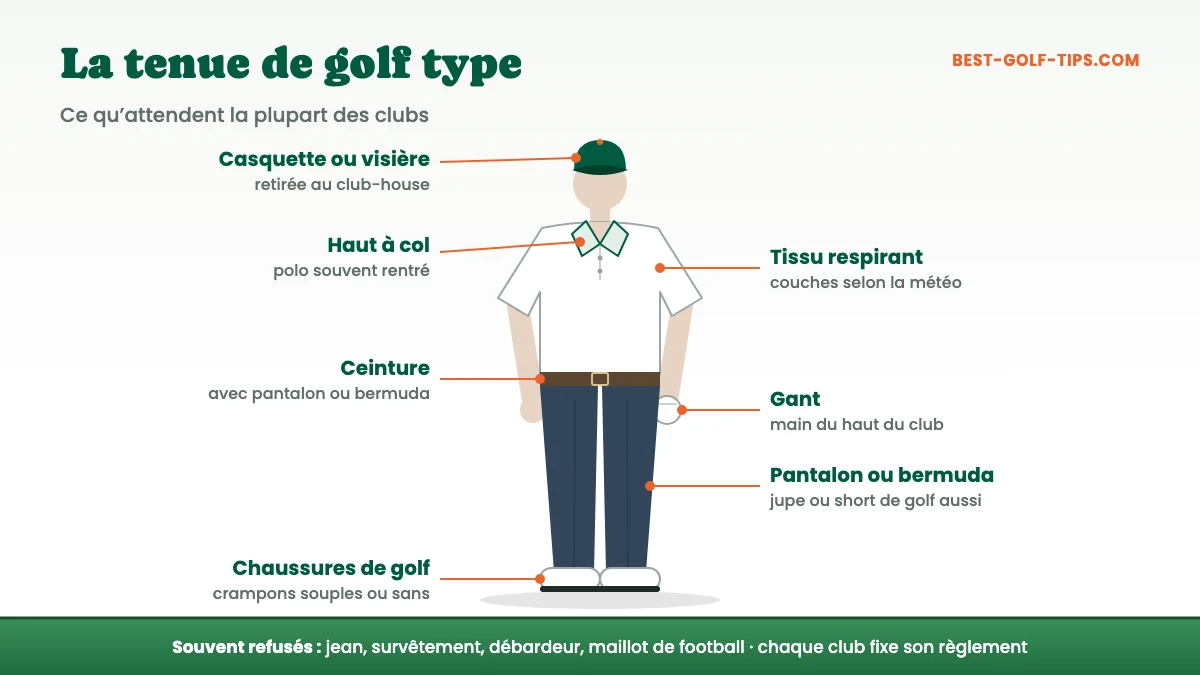
| Element | Generally expected | Often rejected |
|---|---|---|
| Top | A collared polo shirt, collared top, sweater, or simple sweatshirt on top | Tank tops, soccer jerseys, team sports jerseys, and T-shirts with slogans |
| Bottom | Dress pants or golf pants, Bermuda shorts, skirts, or golf shorts | Jeans, sweatpants, swim shorts, or athletic shorts |
| Shoes | Golf shoes with soft spikes or without spikes | Metal cleats, dress shoes with hard soles, sandals |
| Head | Cap or visor, worn with the visor facing forward | Headwear worn inside the clubhouse |
The top: all about the collar
The collared polo shirt is the staple item. Many clubs require that it be tucked into the pants. A V-neck sweater, a zip-up sweatshirt, or a sleeveless vest can easily be worn over it. Styles made of technical fabric—which are lightweight and breathable—are more comfortable than a thick cotton polo shirt during four hours of play.
Bottom: pants, Bermuda shorts, or a golf skirt
Chinos or golf pants, worn with a belt, are appropriate anywhere. Bermuda shorts are accepted at the vast majority of clubs in the summer; some specify the length. For women, skirts, skorts, or golf shorts are permitted. Jeans remain the most common item to be refused, even at fairly casual golf courses.
Shoes: The Most Important Element
They're what give you traction during your swing and protect the course. There are two types: shoes that flexible cleats, made of plastic, which grip well on wet ground, and the models without cleats, with spiked soles, which are more versatile. Metal spikes are now banned by most clubs because they damage the greens. For a first time on the driving range, a clean pair of sneakers is usually enough.
Must-Have Accessories
- The glove: It is worn on the hand that holds the top of the club—the left hand for a right-handed player. It improves your grip on the club and prevents blisters.
- The cap or visor: It protects you from the sun and helps you track the ball. You should take it off when entering the clubhouse and, as a courtesy, when shaking hands with your playing partners at the end of the round.
- The bag: a lightweight tripod bag that can be carried over the shoulder, or a larger cart bag. The rules limit the number of clubs you can carry to 14.
- Small Equipment: tees, a ball marker, a pitch marker, a towel, and a few spare balls.
Things That Are Often Prohibited on the Course
- Jeans, regardless of its color or style.
- The tracksuit and athletic shorts.
- The tank top and the crew-neck T-shirt—at least for men.
- The soccer jersey or another sports team.
- Shoes with metal cleats and ill-fitting shoes.
These restrictions are not universal: some golf courses allow T-shirts or athletic shorts, while others have stricter rules than those listed here. The club’s rules always take precedence, and the pro shop may deny access to the course to anyone not dressed in accordance with the rules.
How should you dress for the weather?
In Cold Weather: The Layering System
Layer your clothes rather than piling on a heavy coat, which would hinder your range of motion. Start with a thermal base layer, a polo shirt, a thin sweater, or a windbreaker, and then perhaps a sleeveless down jacket. Wear a hat and winter gloves between shots. You’ll want to take off a layer as the sun comes up.
In the Rain
A waterproof jacket and pants—loose enough to swing in—make all the difference. Don’t forget a golf umbrella, a dry towel in your bag, and, if possible, a pair of rain gloves, which provide a better grip once they’re wet. Waterproof shoes will keep your feet from getting soaked by the time you finish the course.
During a heat wave
Choose light-colored, breathable clothing, a cap or visor, and sunscreen—which you should reapply during your round. Bring plenty of water: an 18-hole round often lasts more than four hours, mostly in the sun.
Men, Women, Children: What Are the Differences?
For the men, the dress code is the most strictly defined: collared shirt, polo shirt tucked in, no jeans. For the women, clubs are often a bit more flexible: a collarless top with sleeves is frequently allowed, as are skirts, skirt-shorts, and golf dresses of a reasonable length. For the children, golf schools mainly require comfortable clothing and appropriate shoes; on the course, the club’s rules apply just as they do for adults. If you’re a beginner, our guide How to Play Golf outlines the steps to take before your first outing.
Beyond Attire: Etiquette on the Course
Dressing appropriately isn't enough: your partners will remember your behavior above all else. The basic principles of Golf Etiquette are simple:
- Be punctual. Arrive early enough to register, warm up, and be at the starting line on time.
- Repair the field. Replace or fill in your divots, mark the pitches on the green and rake the bunker after your shot.
- Keep quiet. Do not talk or move while a partner is playing, and do not stand in their way. Put your phone on silent.
- Play without dawdling. Be ready when it's your turn, and let a faster player go ahead if you're slowing down the game.
To learn all about the basics of the game, check out our page on Golf Rules and Etiquette.
Video Lessons to Get You Started
 A 5-Minute Warm-Up Before You Head Out: A Physical Therapist’s Pre-Shot RoutinePhilippe Vignon · 6 min
 How to Hold a Golf Club: A Beginner's GuideFlorent Alès · 22 min
To get started, check out our Free golf lessons, or browse all Lessons on the rules and the basics of golf.
Frequently Asked Questions About Golf Attire
Can you play golf in jeans?
At most clubs, no: jeans are the most common item prohibited. Some public golf courses or driving ranges allow them. Always check the club's rules before you come.
Do you have to wear golf shoes?
On the course, most clubs require golf shoes with soft spikes or spikeless soles. For a first time at the driving range, clean sneakers are usually sufficient.
Are Bermuda shorts allowed on the golf course?
Yes, at the vast majority of clubs, especially in the summer. Some specify the length. Sports shorts or swim shorts, on the other hand, are almost always prohibited.
On which hand do you wear a golf glove?
On the hand at the top of the club: the left hand for a right-hander, the right hand for a left-hander. Some players wear one on each hand, especially in cold or damp weather.