

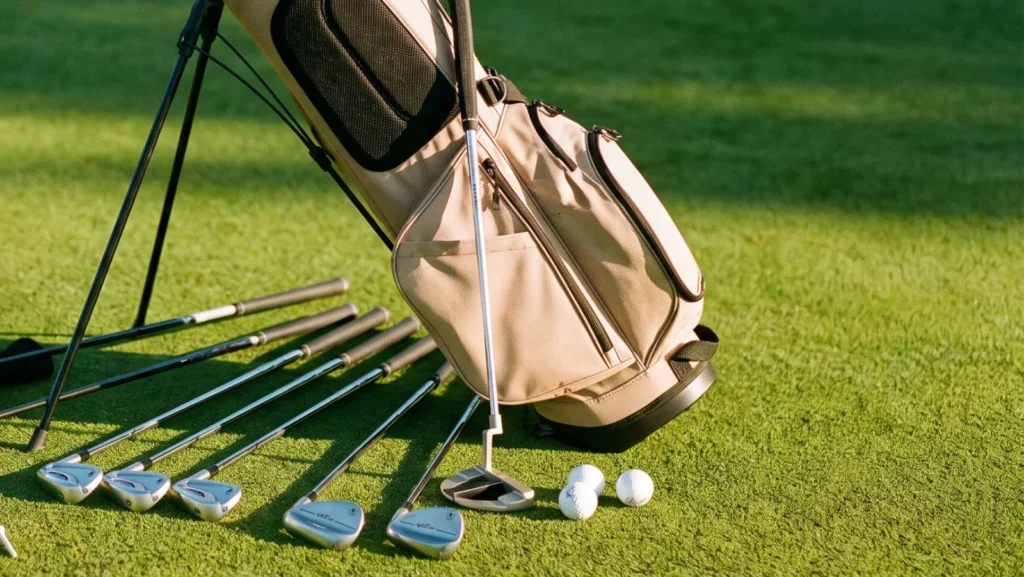
When you're just starting out, it's tempting to buy a complete set or the clubs the pros use. That's a bad idea: a beginner needs clubs tolerant, in small numbers, suited to your swing speed. Here’s how many clubs to bring, which ones to choose, whether you need a fitting, and when to add to your bag—with video tips from instructors and equipment testers.
How many clubs do you need to get started?
The regulation permits A maximum of 14 clubs in the bag, but no one needs 14 clubs to get started. Seven or eight clubs are enough For the first part, half a set may be enough for quite a while.
A typical beginner's bag, as recommended by many teachers:
- wood: a forgiving driver or a fairway wood, which is often easier to hit than a driver when you're just starting out;
- a 5-wood or 7-wood, or a hybrid, to replace the long irons (irons 4 and 5), which are difficult to install;
- three irons: 7, 8, and 9;
- two wedges: pitching wedge and sand wedge;
- a putter, the club you'll use most often on the course.
To learn about each club's role, see our guide Types of Golf Clubs and the one on the Average Distances by Club.
Which Clubs to Choose: Tolerance Above All Else
A “forgiving” club makes up for off-center hits: the ball veers less off course and loses less distance. For a beginner, this is the number-one factor, even more important than distance or brand.
- Cavity-back irons and wedges rather than blades: blades require a level of precision that few hobbyists possess.
- A hybrid or a 7-wood rather than long irons: they get the ball in the air much more easily, and the hybrid is also useful around the green.
- A driver with loft: around 10.5 to 11.5° for a beginner man, at least 11.5° for seniors and women, according to the instructor Kevin Faivre.
- Graphite handles, which are lighter than steel, are often recommended for beginners.
- A simple putter, one that appeals to you visually. A more stable mallet helps with alignment and is forgiving of off-center hits. See our guide The putter: How to Choose One.
The Shaft and Grip: Based on Your Swing, Not Your Skill Level
The shaft is chosen first based on your swing speed. A shaft that’s too stiff for your swing speed causes the ball to launch too low; a shaft that’s too flexible causes it to rise and fly erratically. Being a beginner doesn’t mean you need a “flexible shaft”—it’s your swing speed that determines the right one.
The size of the grip matters, too. A grip that’s too small—where your fingers touch your palm—can cause your hands to rotate too much at impact. Finally, the lie angle depends on your height: a straighter club for taller players, and a flatter one for shorter players.
Should you get a fitting when you're just starting out?
The fitting involves adjusting your clubs (length, lie, shaft, grip, head) to fit your body type and swing. “Standard” clubs are designed for a standard golfer, which is rare. But a fitting only really makes sense if your swing is already fairly consistent.
A piece of advice from the Golfiteurs’ instructors: Before you invest, you have to succeed six or seven out of ten successful contacts. In the meantime, a used, well-fitting pair will do just fine. When the time comes, a fitter can offer you a combo series: Irons that are precise on the shorter shots and more forgiving on the longer ones, ensuring consistent distance gaps between each club.
New or Used: When and How Should You Buy?
- Price is not a factor. An expensive club isn't necessarily one that helps you play better.
- Try it on the course rather than at the driving range, and tell the salesperson your actual distances, not your best shots.
- The Opportunity is a good choice for beginners, as long as you get guidance from a pro on the head and neck.
- Fill up your bag when you consistently fall short of a certain distance on the course—not before.
Video Lessons on How to Choose the Right Clubs
 Golf Equipment for Beginners: Clubs, Balls, and AccessoriesKevin Faivre · 11 min
 Which clubs should you bring for your first round of golf?Golfbidder · 9 min
 The 7 Types of Forgiving Clubs for a Beginner's SetGolf Monthly · 12 min
 6 Tips Before Buying Your First Set of ClubsGolf Monthly · 6 min
 Getting Fitted: Lie, Grip, and Putter Tailored to Your GameGood Good · 9 min
 Iron Fitting: Combo Set, Shaft, and Grip Tailored to Your GameLewis Wallace · 14 min
 Changing Clubs: 3 Tips Before You BuyJoël Bernard · 8 min
 Half Set or Full Set: When Should You Buy Your Clubs?The Golfers · 5 min
All videos about equipment are grouped together in this category Equipment and Fitting.
Frequently Asked Questions About Choosing Clubs
How many clubs do you need to get started in golf?
Seven or eight clubs are enough: a wood, a hybrid, or a 5-wood or 7-iron; a 7-, 8-, and 9-iron; a pitching wedge; a sand wedge; and a putter. The rules allow for a maximum of 14 clubs.
Should you buy a complete set when you're just starting out?
No. A half-set of forgiving clubs—whether new or used—is more than enough to start with. You can add to your bag when you find yourself consistently missing a certain distance on the course.
Which driver should a beginner choose?
A forgiving driver with plenty of loft: about 10.5 to 11.5° for a male beginner and at least 11.5° for seniors and women. A fairway wood can also be used instead of a driver when you're just starting out.
When should you get your clubs fitted?
When your movement becomes somewhat consistent—for example, six or seven correct hits out of ten. Before that, fine-tuning has little effect.