


The handicap is the number that summarizes your skill level as a golfer. It allows you to play on equal terms with partners who are stronger or weaker than you, on any course. Here’s the difference between the handicap and the playing handicap, the calculation formula used by the World Handicap System (WHS), and a step-by-step example with numbers.
Index and Handicap: What's the Difference?
The two words are often used interchangeably, but they do not mean the same thing.
- The Index measures your skill level, regardless of the course. It's a number with one decimal place, such as 18.2. It follows you from one golf course to the next.
- Gambling Addiction is the number of strokes you take on a given course, starting from specified tees. It is a whole number, calculated based on your handicap and the course's difficulty.
In practical terms, a player with a handicap index of 18.2 will receive a few more strokes on a difficult course and a few fewer on an easy course. The handicap index doesn’t change; the playing handicap does.
How does the WHS system work?
Since 2020, France has been using the World Handicap System (WHS), the handicap system used by most golfing nations. In France, it is administered by the French Golf Federation. The principle is simple:
- each scorecard recorded gives a differential, which converts your score into a skill level;
- your handicap is the average of the 8 Best Differentials among your Last 20 cards;
- The maximum handicap is 54.
Since only the last 20 cards count, the index reflects your actual form. A very bad game doesn’t carry much weight—it probably won’t be among the top 8. As long as you have fewer than 20 cards, the calculation adjusts and considers a smaller number of score differences.
How do you calculate your score differential?
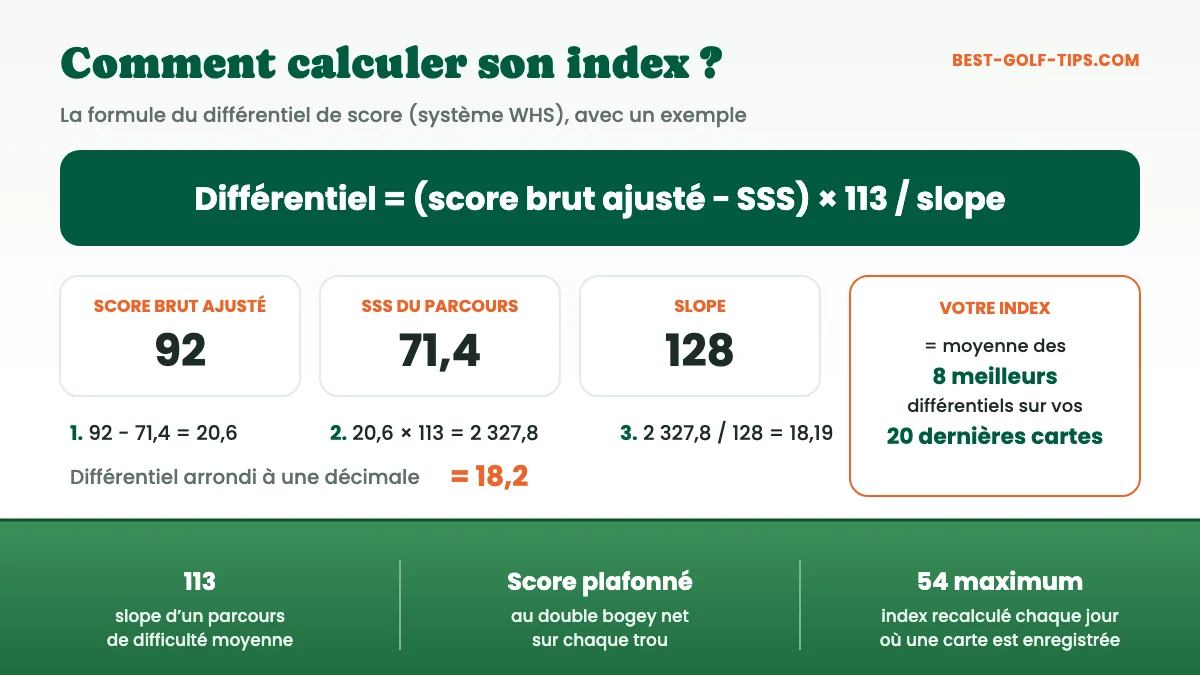
The differential formula is as follows:
Differential = (adjusted raw score − SSS) × 113 / slope
| Term | What It Is | Where to find it |
|---|---|---|
| Adjusted Raw Score | Your total number of strokes, after capping the number of bad holes | Your scorecard |
| SSS (Course Rating) | The expected score for a very good player (their handicap 0) on the course | The scorecard or the tee times chart |
| Slope | The course's difficulty for an average player, from 55 to 155 | The scorecard or the tee times chart |
| 113 | The slope of a moderately difficult course | Fixed value in the formula |
The SSS and the slope depend on the shots played: they are not the same for white, yellow, blue, or red balls. On competition day, an adjustment may also be applied to the differential if playing conditions were significantly more difficult or easier than usual.
Adjusted Gross Score: The Maximum Per Hole
To prevent a disastrous hole from skewing the calculation, the score for each hole is capped at net double bogey: the par for the hole, plus two strokes, plus any strokes you receive on that hole. If you receive a stroke on a par-4 hole, your recorded score cannot exceed 7, even if you played 9. A double bogey A net score is therefore the worst possible score on a hole.
Step-by-Step Example of an Index Calculation
Let's consider a round played on a course with an SSS of 71.4 and a slope of 128, with an adjusted gross score of 92.
- Difference from the SSS: 92 − 71.4 = 20.6.
- Multiplying by 113: 20.6 × 113 = 2,327.8.
- Division by the slope: 2,327.8 / 128 = 18.19, rounded to 18,2.
This differential of 18.2 is added to the list of your last 20 differentials. If, among these 20 cards, your 8 best differentials are 16.8; 17.1; 17.5; 17.9; 18.2; 18.4; 18.9; and 19.2, their sum is 144, and your handicap becomes 144 / 8 = 18,0.
The same score of 92 on a more difficult course with a higher slope rating would result in a smaller differential: that's the whole point of the slope rating.
From your handicap to your golf handicap: How many strokes do you get?
Before teeing off, your handicap is converted into a course handicap for the holes you play:
Golf handicap = handicap × slope / 113 + (SSS − par), rounded to the nearest whole number.
With a handicap of 18.2, on the course in the example (slope 128, SSS 71.4, par 72): 18.2 × 128 / 113 = 20.6, then 20.6 + (71.4 − 72) = 20.0. You receive 20 shots over 18 holes. These strokes are distributed among the holes based on their difficulty, which is indicated on the scorecard. Golf clubs generally post a conversion chart to save players from having to do the math. In competitions, depending on the format of play, the organizer may apply only a portion of this handicap.
The net is then calculated simply: one point scored while receiving a shot is worth one birdie net, a bogey A shot played after being struck counts as a net par.
Base Handicap, Caps, and Updates: What You Need to Know
- Starting handicap: In France, every beginner golfer starts with a handicap of 54, the maximum; their first recorded scores then lower that number.
- Daily update: The handicap is recalculated every day that a new score is recorded.
- Maximum increase limits: Your handicap cannot rise too quickly compared to your best handicap over the past 12 months. After 3 upward moves, the increase is halved, and it can never exceed 5 moves.
- Exceptional score: A difference of at least 7 strokes below your handicap lowers your handicap by one additional stroke, and by two strokes if the difference is 10 strokes or more.
- 9-hole courses: They are accepted and converted for use in the calculation.
Where can I check their golf handicap?
In France, your handicap and your map history are available in your member portal on the federation's website, ffgolf.org, as well as in the federation’s mobile app. There, you can see your last 20 scorecards, the 8 selected differentials, and how your handicap has changed. The club where you play can also provide you with this information.
To fill out a scorecard correctly and learn the vocabulary related to scoring, see our page on Golf Rules and Etiquette.
Video lessons to lower your handicap
 Scoring within 110 yards, with Tiger Woods and Nelly KordaTiger Woods and Nelly Korda · 16 min
 Zone-Based Course Strategy: A Lesson from a Shopping CartCyril Miranda · 33 min
 Tiger Woods' Course Management: Starting from the GreenTiger Woods · 7 min
 Justin Rose's Tips for Making More BirdiesJustin Rose · 5 min
To save strokes without changing your swing, check out the lessons at Course Management, or sign up for the free program Master the Mental Game in 7 Steps.
In club settings, the most common method for recording scorecards is Stableford, with its scoring system.
Frequently Asked Questions About the Golf Handicap
How is the golf handicap calculated?
Your handicap is the average of the 8 best differentials from your last 20 cards. Each differential is calculated as (adjusted gross score − SSS) × 113 / slope.
What is the maximum handicap in golf?
The maximum handicap is 54. This is also where a new player starts, before their first cards lower their handicap.
What is the difference between a golf handicap and an index?
The handicap index measures your skill level, regardless of the course. Your playing handicap is the number of strokes you are allowed on a given course and from specific tees: it depends on your handicap index, the slope, and the SSS.
How often is the handicap updated?
The handicap is recalculated every day a new scorecard is submitted. You can track it in your ffgolf member portal and in the federation’s app.