

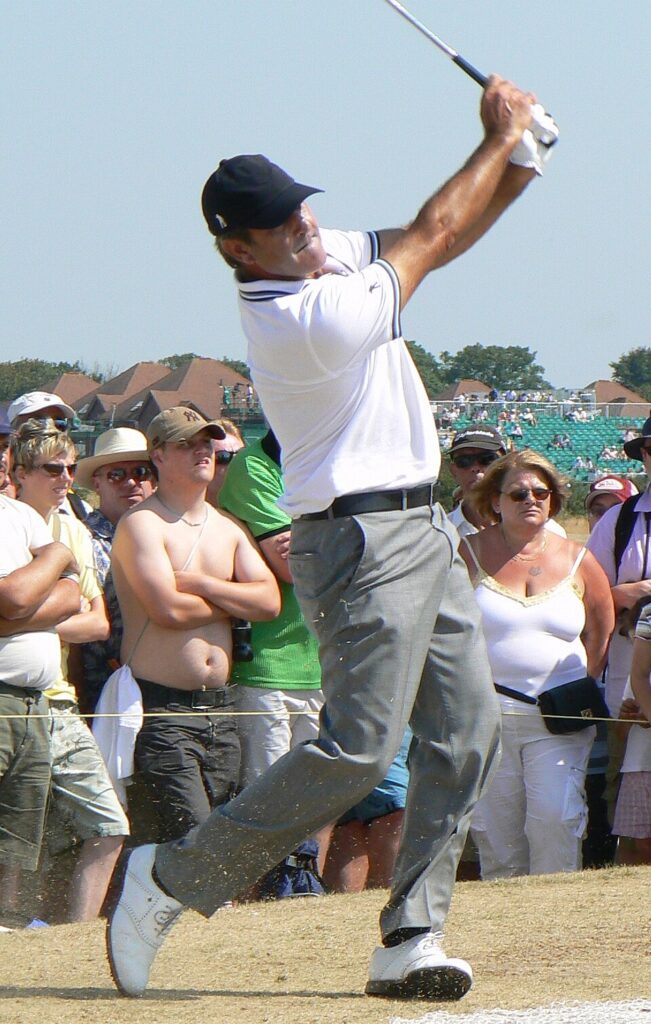
Five majors, a record 50 wins on the European Tour, four French Opens, and a victorious captain of the 1997 Ryder Cup: Seve Ballesteros, the magician of the short game.
Seve Ballesteros He is the player who put European golf on the world stage: five major championships, a record 50 victories on the European Tour, and a Ryder Cup in which he made his mark first as a player and then as captain. Here is his biography, his list of achievements, his playing style, and his legacy, along with lessons from the site on how to work on your short game his way.
Who is Seve Ballesteros?
Severiano “Seve” Ballesteros was a Spanish golfer, born on April 9, 1957, in Pedreña, Cantabria, who passed away in 2011. He learned to play golf near his home, often using just one club, and turned professional in March 1974 at the age of 16. At age 19, he finished second at the 1976 Open at Royal Birkdale, tied with Jack Nicklaus, and that same season won the European Order of Merit; he remains its youngest winner.
In 1979, he won the Open at Royal Lytham and became the first player from continental Europe to win a major since the Frenchman Arnaud Massy in 1907. In 1980, at age 23, he became the first European to don the green jacket at the Masters, making him the youngest winner in the tournament’s history. He won the Masters again in 1983, then the Open in 1984 at St. Andrews and in 1988 at Royal Lytham. He was ranked No. 1 in the world for 61 weeks between 1986 and 1989, and was inducted into the World Golf Hall of Fame in 1999.
France holds a special place in his career: he won the French Open four times—in 1977 at Le Touquet, in 1982 at Saint-Nom-la-Bretèche, and in 1985 and 1986 at La Boulie. It is the tournament he has won the most times.
Seve Ballesteros's Career Highlights
| Tournament or Record | Result |
|---|---|
| Major Tournaments | 5: Open Championship 1979, 1984, 1988; Masters 1980, 1983 |
| Victories on the European Tour | 50, a track record, with at least one victory every year from 1976 to 1992 |
| French Open | 4 championships: 1977, 1982, 1985, 1986 |
| Ryder Cup (player) | 8 appearances from 1979 to 1995, 22.5 points; European titles in 1985, 1987, and 1995; title retained in 1989 (tie) |
| Ryder Cup (captain) | Europe's victory in 1997 at Valderrama |
| World Rankings | No. 1 for 61 weeks (1986–1989) |
| Honors | World Golf Hall of Fame (1999) |
Seve Ballesteros' Game: Imagination and Short Game
Seve wasn't the most consistent player in the game, but no player of his era was as skilled at getting himself out of impossible situations. His golf was based on imagination: seeing a shot that no one else saw, and then making it.
The King of Recovery Shots
The most famous moment remains the 1979 Open: on the 16th hole of the final round, his drive landed in a parking lot, yet he still managed to make a birdie. You can work on this ability to save a shot with the lessons in this section Hazards and Trouble Shots: step out from behind the trees, play it safe, choose the safest option over the most spectacular one.
The feel around the green
Seve is best remembered as a genius of the short game: chips, lobs, bunker shots—he varied his trajectories with the same club and played as much with his hands as with his head. There are no official video lessons by him that do justice to his talent, but the lessons on the website about the short game reflect his principles: reading the lie, choosing the landing spot, and using the club’s bounce. Start by wedge play, pitching, and chipping, Pitch Shots and Bunker shot.
The Legacy of Seve Ballesteros
The European Spirit of the Ryder Cup
In 1979, Seve and his compatriot Antonio Garrido became the first players from continental Europe to compete in the Ryder Cup. Together with José María Olazábal, he went on to form the most successful pairing in the tournament’s history: 11 wins and 2 ties in 15 matches. In 1997, as captain at Valderrama, he led Europe to victory in the first Ryder Cup held on the continent. In 2012, the European team played with his silhouette embroidered on their uniforms.
A role model for Spanish and European players
Olazábal, followed by Sergio García and Jon Rahm, followed the path he paved at the Masters. Rahm says that, had it not been for the 1997 Ryder Cup at Valderrama, he likely would not have become a golfer; he dedicated his 2023 Masters victory—won on April 9, his birthday—to Seve. Since 2017, the European Tour’s Player of the Year award, voted on by his peers, has borne his name. In France, where he won four Opens, you can also find profiles of the French Ryder Cup players. Thomas Levet, Jean Van de Velde and Victor Dubuisson, another “magician” of the short game.
See also the profiles of his main rivals Jack Nicklaus, Tom Watson and Gary Player.
Frequently Asked Questions About Seve Ballesteros: Career Highlights, the Ryder Cup, and the Legacy of "The Magician"
How many majors did Seve Ballesteros win?
Five: three Open Championships (1979, 1984, 1988) and two Masters (1980, 1983). In 1980, he became the first European to win the Masters.
How many tournaments did Seve Ballesteros win on the European Tour?
50, a circuit record, with at least one victory every year from 1976 to 1992.
Did Seve Ballesteros win the French Open?
Yes, four times: in 1977, 1982, 1985, and 1986. It's the tournament he's won the most times.
What is Seve Ballesteros's record in the Ryder Cup?
He competed eight times as a player, from 1979 to 1995, with a total of 22.5 points. Together with José María Olazábal, he forms the most successful duo in history (11 wins and 2 ties in 15 matches). As captain in 1997 at Valderrama, he led Europe to victory.
What is Seve Ballesteros's nationality?
Spanish: He was born on April 9, 1957, in Pedreña, Cantabria.
Why is Seve Ballesteros said to have been a genius at the short game?
For his creativity and his recovery shots: at the 1979 Open, he made a birdie on the 16th hole of the final round after his drive landed in a parking lot. Around the green, he varied his shots using the same club.
Are there any video golf lessons by Seve Ballesteros?
There are no official lessons by him on this site that do justice to his talent. To work on your short game in the spirit of his teaching, check out the sections on wedge play, pitching, and chipping, as well as pitch shots and bunker shots.