

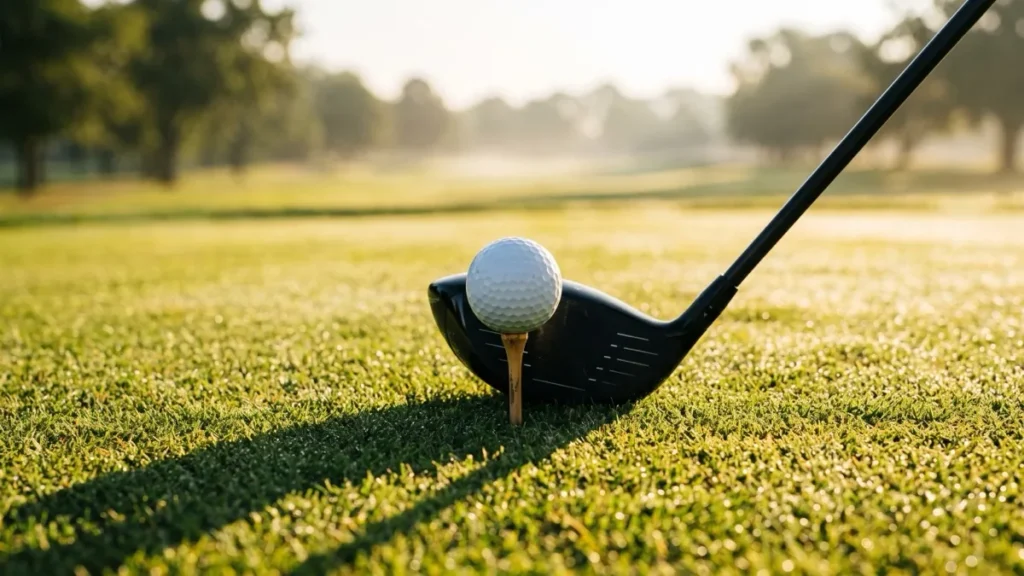
The tee is the smallest piece of equipment in your bag, yet it plays a major role in your tee shot. If it’s too high, the ball soars; if it’s too low, it doesn’t get off the ground. Here’s the correct height for each club, what the rules say, and the three mistakes that cost you the most strokes.
What is a tee in golf?
A tee is a small support, made of wood, plastic, or bamboo, that is stuck into the ground to raise the ball. It may only be used at the tee box of each hole, on the teeing area marked by two colored markers. Elsewhere on the course, whether on the fairway or in the rough, the ball is played as it lies.
By extension, the word also refers to the tee box itself: we say “head to the 1st tee” or “play from the yellow tees.” The tee colors are explained in a video in our lesson on the starting balls and colors.
At what height should you place your tee depending on the club?
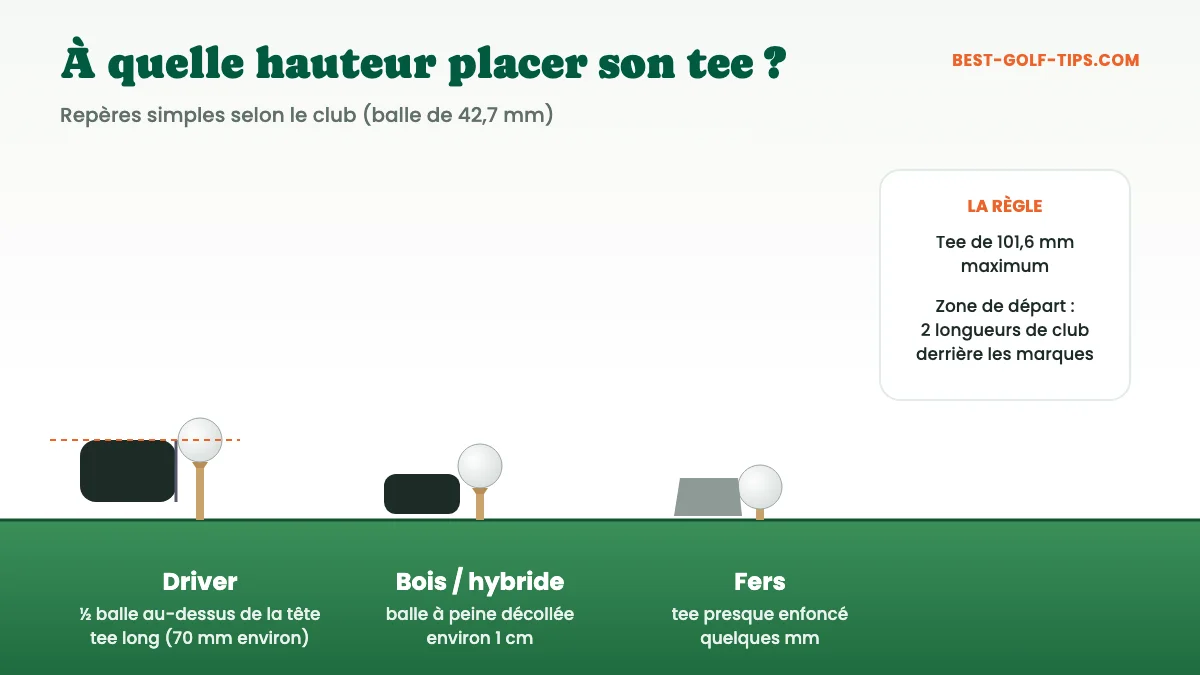
| Club | Recommended height | Visual cue | Tee to use |
|---|---|---|---|
| Driver | High | The ball is halfway above the top of the head | Long tee (70 to 83 mm) |
| Fairway Woods | Bass | The ball had barely left the grass; it was about 1 cm | Short tee (38 to 54 mm) |
| Hybrid | Bass | Like wood, or almost level with the grass | Short tee |
| Irons (set of 3) | Very low | Tee almost completely pushed in, a few millimeters | Short tee |
With the driver: half the ball above your head
The driver is the only club you swing up slightly after the lowest point of your swing. The ball should therefore be positioned high: place the clubhead behind it, and half of the ball should extend above the top of the clubhead. This setup helps you strike the ball in the center of the clubface—or slightly above it—where the ball flies with the least spin and the most distance. It goes hand in hand with positioning the ball toward your front foot; the exact reference point is explained in the lesson on The ball position when using a driver.
With the fairway wood and the hybrid: barely off the ground
These clubs have a small head and a low face. A ball that’s too high would go under the face. Lift it just enough to get the perfect lie—about one centimeter—and hit it with a sweeping motion, without trying to lift it. To avoid topping the hybrid, a simple exercise is to aim for a tee placed in front of the ball.
With irons: almost at ground level
On a par-3 hole, using a tee isn’t required, but it provides a perfect lie. When hitting with an iron, you strike the ball on the way down before it hits the ground; therefore, the tee must be almost completely driven into the ground so that the ball sits as it would on an ideal fairway. If the tee is too high, the clubface will pass under the ball, resulting in a high, short shot.
What the Rules of Golf Say About the Tee
- Maximum size: A tee must not exceed 101.6 mm (4 inches), and it must not be used to mark the line of play.
- Starting area: It is a rectangle two club lengths deep, behind the line connecting the two markers. The ball must be placed there; your feet, however, may be outside the rectangle.
- Ball falling off the tee: If it falls before you've taken your shot, you may replace it without penalty. If you've swung at it—even if you completely missed it—the stroke counts.
- For the rest of the course: The tee is off-limits. The only exception is when the rules require it (lost ball, out of bounds), in which case a new shot may be taken from the teeing area.
To learn more about the basics of the game, see our page on Golf Rules and Etiquette.
Wood, plastic, or bamboo: Which tee should you choose?
The wooden tee It's the classic: it's inexpensive, but it often breaks when hitting with a driver. The plastic tee lasts much longer, and some models with notches let you always return to the same height, which is handy for making progress. The Bamboo T-Shirt is stronger than wood and more environmentally friendly. As for length, bring some long tees (70 mm, or even 83 mm for large-headed drivers) and a handful of short tees for woods, hybrids, and par-3s.
The 3 Most Common Mistakes When Using a Tee
- The same tee for all clubs. Hitting a high shot with an iron is the best way to get under it. Adjust the height based on the club for each shot.
- A tee that's too high when hitting with the driver. The ball hits the top of the clubface—or even the very top of the head—resulting in a high, short shot. If this happens to you often, lower the tee slightly before changing your swing.
- A tee that's too low when hitting a driver. The ball is struck on the lower part of the clubface, starts low with too much spin, and loses distance. This is often the case with beginners who are afraid of “missing” the ball.
Pros sometimes adjust the tee height to control their shot: a slightly lower tee for a safety shot, as shown Tommy Fleetwood, or not even a tee at all, like Sergio García who takes out his driver from the fairway.
Video Lessons to Help You Drive Better
 Precision Drive: Tommy Fleetwood's Safety TeeTommy Fleetwood · 14 min
 Driver Ball Position: The Sternum CheckpointLesson · 8 min
 Sergio Garcia's tee-less driver shot from the fairwaySergio Garcia · 3 min
 Bonus: Tiger Woods' putting drill with two teesTiger Woods · 11 min
For a complete guide, follow the free program Drive the Ball Better in 7 Steps, or browse all video driving lessons.
Frequently Asked Questions About the Tee
Can a tee be used anywhere other than at the tee box?
No. The tee is allowed only in the teeing area of the hole being played. On the fairway, in the rough, or in a bunker, the ball must be played as it lies.
What should you do if the ball falls off the tee?
If you haven't taken the shot yet, you may replace the ball without penalty. If you took a swing with the intention of hitting the ball—even if you missed it—the shot counts.
Is a tee required on a par-3 hole?
No, it's optional. But it provides the perfect lie: you just need to push it in almost all the way so that the ball is just above the grass.
What size tee should I buy?
Long tees measuring 70 mm for the driver (83 mm for large clubheads) and short tees ranging from 38 to 54 mm for woods, hybrids, and irons. The rule sets a maximum of 101.6 mm.