


Stableford is the most commonly played competition format in golf clubs. Instead of counting all your strokes, you earn points on each hole based on how you score relative to par. So a bad hole won’t ruin your scorecard. Here’s the scoring system, the difference between gross and net scores, a step-by-step example with numbers, and when to pick up your ball.
What is the Stableford scoring system in golf?
Stableford is a scoring system in points. On each hole, you earn a number of points based on how your score compares to the hole’s par. At the end of the round, the points are added up: the player with the most points wins. This is the opposite of stroke play, where strokes are added up and the lowest score wins.
Its big advantage: a disastrous hole is simply worth 0 points. It doesn't cost you 4 or 5 strokes on your total score, as it does in stroke play.
How many points is each score worth?
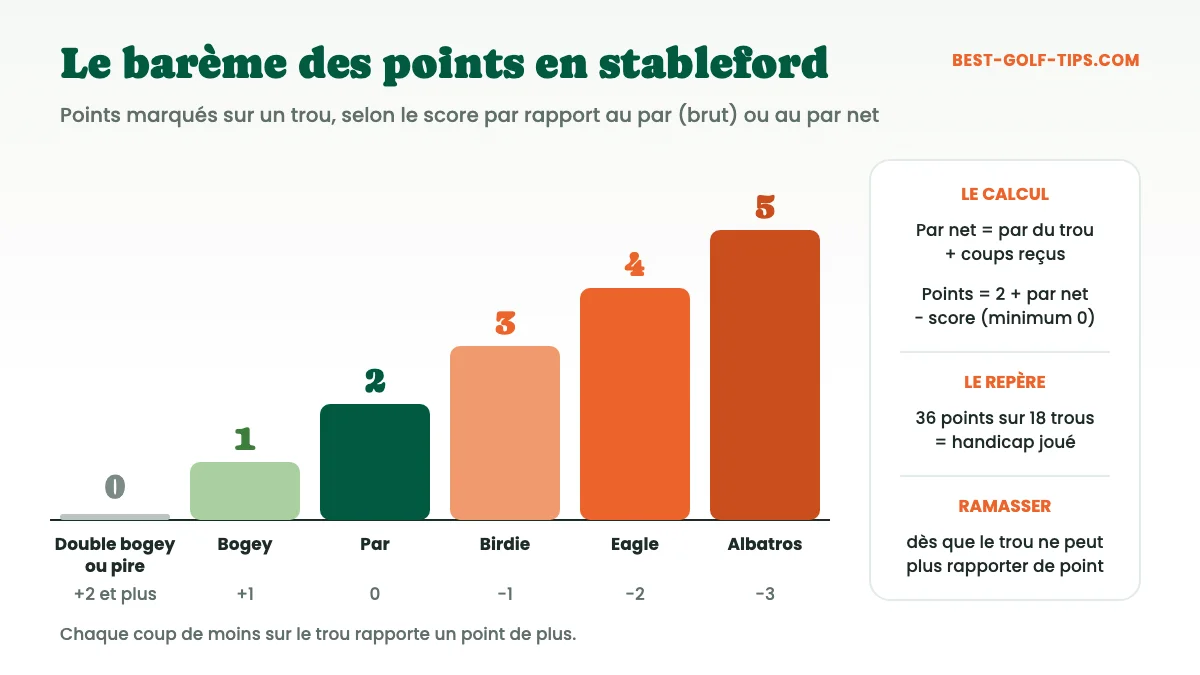
| Score on the hole | Compared to the par | Points |
|---|---|---|
| Double bogey or worse | +2 or more | 0 |
| Bogey | +1 | 1 |
| By | 0 | 2 |
| Birdie | −1 | 3 |
| Eagle | −2 | 4 |
| Albatross | −3 | 5 |
The logic is simple: par is worth 2 points; each shot over par subtracts one point, and each shot under par adds one point. The score never goes below 0.
Gross or net Stableford: What's the difference?
Gross Stableford
In gross scoring, your score is compared to the hole's par, without taking your handicap into account. This is the ranking of the best players—the one that rewards pure skill.
Net Stableford
To put it simply, you take hits based on your playing handicap. These strokes are distributed among the holes based on their difficulty, which is indicated on the scorecard in the “handicap” (or “HCP”) column, ranging from 1 for the most difficult hole to 18 for the easiest.
- 10-point handicap: You get 1 stroke on the holes ranked 1 through 10, and none on the others.
- 18-stroke handicap: 1 shot on each hole.
- 24-point point spread: One shot on each hole, plus a second shot on holes 1 through 6.
The par for the hole, plus any penalty strokes, becomes your “net par.” This net par is used to calculate your score. Most club tournaments offer both gross and net rankings.
Example with Numbers: How to Count Your Points Over 4 Holes
Let's take a player with a handicap of 22. He receives one stroke on each hole, plus a second stroke on holes numbered 1 through 4.
| Hole | Per / Hole Handicap | Blows Received | Online | Score | Net Points | Raw points |
|---|---|---|---|---|---|---|
| 1 | Page 4 of 7 | 1 | 5 | 6 | 1 | 0 |
| 2 | 5 / 3 | 2 | 7 | 6 | 3 | 1 |
| 3 | Page 3 of 15 | 1 | 4 | 4 | 2 | 1 |
| 4 | 4 to 1 | 2 | 6 | Picked up | 0 | 0 |
| Total | 6 | 2 |
- Hole 1: 6 strokes for a net par of 5 is a net bogey: 1 point. On a gross basis, 6 on a par-4 hole is a double bogey: 0 points.
- Hole 2: 6 strokes for a net par of 7, a net birdie: 3 points. Gross, that's a bogey: 1 point.
- Hole 3: 4 strokes for a net par of 4: 2 points net, 1 gross.
- Hole 4: After 7 strokes, the ball is not in the hole. With a net par of 6, the best score still possible is 8—a net double bogey worth 0 points. The player picks up his ball.
Over 18 holes, a total of 36 net points means that you played exactly to your handicap: an average of 2 points per hole.
When should you pick up your ball in Stableford?
As soon as you can no longer score on the hole, pick up your ball. In practice, this is the case when you’ve played your net par plus one stroke without finishing the hole. Picking up your ball is not a penalty; it’s a courtesy that speeds up play for everyone.
On the scorecard, your marker will draw a line or leave the box blank for that hole. Note that the player remains responsible for recording the number of strokes per hole; the committee is responsible for calculating the points. For other rules of the game, see our page on Golf Rules and Etiquette.
Why is Stableford the most popular scoring system in clubs?
- He forgives mistakes. A missed putt costs, at most, 2 points off net par—never an entire card.
- It speeds up the game. Players pick up their balls as soon as they stop scoring, which prevents endless holes.
- It brings together all levels. Thanks to the strokes he receives, a player with a 30 handicap can beat a player with a 5 handicap.
- It counts toward the handicap. A Stableford competition, played under the scheduled conditions, counts toward your handicap.
What is the connection between Stableford and the handicap?
Your handicap measures your skill level. Before each round, it is converted into a playing handicap based on the difficulty of the course and the tees used, using the slope and SSS posted at the club. Some tournaments also apply a percentage. It is this playing handicap that determines the number of strokes you receive.
When calculating the handicap, each hole is limited to a net double bogey. Stableford works exactly with this limit, since that score is already worth 0 points. Picking up your ball therefore has no negative effect on the score used to calculate your handicap. As a general rule, the more you exceed 36 points, the more likely it is that your handicap will be lowered.
Video Lessons to Score More Points
 Tiger Woods' Course Management: Starting from the GreenTiger Woods · 7 min
 Zone-Based Course Strategy: A Lesson from a Shopping CartCyril Miranda · 33 min
 Justin Rose's Tips for Making More BirdiesJustin Rose · 5 min
 Scoring from Inside 100 Yards with Tiger Woods and Nelly KordaNelly Korda · 16 min
To avoid scoring 0 points on any hole, play all video lessons on course management, or sign up for the free program Master the Mental Game in 7 Steps.
Your scores in Stableford count toward your Handicap Index, and the scale is based entirely on the par for each hole.
Frequently Asked Questions About Stableford
How many points do you need to play at your handicap?
36 net points over 18 holes, or an average of 2 points per hole. Over 9 holes, the benchmark is 18 points.
How many points is a hole-in-one worth?
It all depends on the par and any penalty strokes. On a par-3 hole with no penalty strokes, a hole-in-one counts as an eagle: 4 points. With a penalty stroke, it’s worth 5 points.
Should we mark the points on the map?
No, it's not required. You record the number of strokes for each hole; the committee is responsible for calculating the points. Many players still keep track of them anyway to monitor their round.
What is an unfinished hole worth?
0 points. If you pick up your ball because you can no longer make the hole, the hole is worth 0 points, just like a net double bogey.