

Updated on November 11, 2026
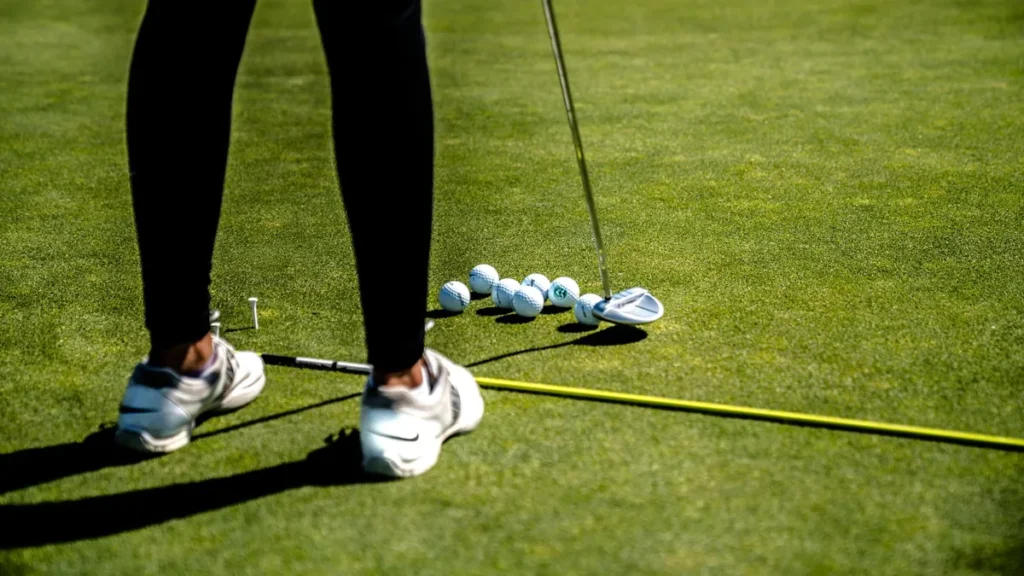
On the PGA Tour, the success rate drops from 99.5% on putts under 0.9 m to 44% on putts between 2.7 and 3 m1: Short putts and speed control make all the difference. A player who scores around 90 makes about half of his putts from 1.5 meters and has about four times as many three-putts as a pro.4. Here are 15 exercises organized by objective, each with instructions on how to set it up, criteria for success, and a lesson from the website demonstrating the exercise.
📌 From what distance do pros sink their putts?
Official PGA Tour figures show a sharp decline: 92.5% between 0.9 and 1.2 meters, 70% between 1.5 and 1.8 meters, and 44% between 2.7 and 3 meters1. Beyond 7.6 m, even the pros only make 5% of their shots2.
- Pros average 0.48 three-putts per round3. Mark Broadie (Columbia University) has calculated that a player who scores around 90 actually scores about 2.3 per turn4. The bottom line: Making short putts and controlling the length of long putts pays off more than aiming for 6-meter putts.
📊 Putting Success Rates on the PGA Tour, by Distance
| Distance from the hole | Distance in feet | Puts Made |
|---|---|---|
| less than 0.9 m | less than 3 | 99,5 % |
| 0.9 to 1.2 m | 3 to 4 | 92,5 % |
| 1.2 to 1.5 m | 4 to 5 | 81,8 % |
| 1.5 to 1.8 m | 5 to 6 | 70,4 % |
| 1.8 to 2.1 m | 6 to 7 | 61,4 % |
| 2.1 to 2.4 m | 7 to 8 | 54,4 % |
| 2.4 to 2.7 m | 8 to 9 | 48,7 % |
| 2.7 to 3 m | 9 to 10 | 44,3 % |
| 3 to 4.6 m | 10 to 15 | 32,8 % |
| 4.6 to 6.1 m | 15 to 20 | 21,3 % |
| 6.1 to 7.6 m | 20 to 25 | 12,6 % |
| more than 7.6 m | more than 25 | 5,4 % |
Source: pgatour.com, statistics for “Putting from 3′” to “10′” (341 to 348) and “Putting from 10–15′” to “> 25′” (405 to 408), 2026 season data as of the World Wide Technology Championship (November 8, 2026), accessed on November 11, 2026. Conversion to meters rounded by us.
✅ Key takeaways
🎬 Our video lessons
🔍 Short putts: 4 exercises to stop missing putts from within 1.5 meters
On a short putt, the direction of the shot depends mainly on the putter face: 80% on the face angle, 17% on the path, and 3% on the point of impact, according to a study of 71 elite players and 1,301 putts5.
- The first two exercises focus on form and alignment. The next two add the pressure of a set you can’t afford to miss.
📊 Exercises 1 through 4: Short putts
| Exercise | Objective | Setup | Successful when |
|---|---|---|---|
| 1. The Two Tees (Tiger Woods) | Hit the ball in the center, square to the ball | 1.20 m from the hole, two tees placed right at the toe and right at the heel of the putter. 20 to 30 putts using only your right hand, then with both hands. | The putter passes between the tees without touching them 8 times out of 10. |
| 2. The Ball Under the Wrist (Adrien Dubois) | Prevent the wrists from turning the face | A one-meter putt on almost flat ground. The ball is wedged between the wrist (or forearm) and the end of the grip; only the torso acts as a pendulum. | The ball stays in place and the putt with a known slope goes in; otherwise, the clubface was misaligned. |
| 3. Rory McIlroy's Ladder | Coming Home Under Pressure | Puts of 3, 4, 5, 6, 7, and then 8 feet (0.9 to 2.4 m) around the hole. | Six consecutive successful putts; if you miss the first one, you have to start over. |
| 4. The 20 Consecutive Puts (Jean-Baptiste Gonnet) | Mental resilience on “gimme” putts” | Twenty putts from two feet (60 cm), going through the full pre-shot routine each time. | Twenty in a row without a mistake; then back up to three feet, then four feet. |
Exercises and criteria taken from the video lessons cited; the “8 out of 10” criterion is from the website’s “7 Steps to Better Putting” program.
✅ Key takeaways
- Square face and centered contact first5
- Then there are series that start over from scratch after the first failure
🎬 Our video lessons
⛳ Line and Alignment: 3 Exercises to Start Off on the Right Foot
In Karlsen's study, the consistency of a Tour player's stroke was enough to sink about 95% of 4-meter putts, whereas in tournaments, pros sink only about 17% of them5. Aiming and reading are therefore just as important as the movement itself.
- These three exercises first test what your eyes see, then the ball's trajectory, and finally the stability of your lower body.
📊 Exercises 5 through 7: The Line
| Exercise | Objective | Setup | Successful when |
|---|---|---|---|
| 5. The String and the Three Bales (Xander Schauffele) | Focus your eyes to see the straight line | A chalk line stretched across a straight putt, with three balls placed against it (6 feet apart, then 9). | At address, the three balls should appear aligned; if not, adjust your head and neck. |
| 6. The Way Out (Jean-Baptiste Gonnet) | Hit the ball along the chosen line | Two tees, barely wider than a ball, planted right in front of her on the tee line. Two rail-like sticks to guide the putter. | The ball passes between the tees without touching them. |
| 7. The card above the knees (ffgolf, Patrice Amadieu) | Stabilize the lower body | A card placed just above the knees, with very light pressure. Variation: a stick held from the face of the putter to the sternum. | The card doesn't move during the putt. |
Exercises and criteria taken from the video lessons cited.
✅ Key takeaways
- Check your alignment, but don't rely on it
- A door right in front of the ball controls the exit
- The lower body doesn't move
🎬 Our video lessons
🧭 Speed Control and Long Puts: 3 Exercises to Avoid Three-Putts
Pros average two putts from 33 feet (10 m); a player who scores around 90 averages two putts from 19 feet (5.8 m)4. The speed control system is the most profitable project.
- What speed should you aim for? Dave Pelz recommended a speed that would cause the ball to land about 17 inches (43 cm) behind the hole if you missed, so that it would roll through the trampled area around the hole7.
📊 Exercises 8–10: Speed control
| Exercise | Objective | Setup | Successful when |
|---|---|---|---|
| 8. The 60-cm Zone (Jean-Baptiste Gonnet) | Don't leave any putts too short or too long | A stick placed 60 cm behind the hole, four balls at 5 m. Then 6, 7, and 8 m, uphill and downhill. | If all four balls in a row land between the hole and the cue stick, you have to start over if any ball falls short or hits the cue stick. |
| 9. The 60% mark (Viktor Hovland) | Feeling the speed on a long putt | For a putt of 12 to 15 meters, place a marker about 60 percent of the way along the line. Take a few practice strokes while looking at that point, then remove the marker. | 8 out of 10 putts from 12 meters end up within one meter of the hole. |
| 10. The Ball Line (Matthieu Pavon) | Work on contact and speed | On a flat putt, the first ball—and then each subsequent ball—must touch the one before it. Five sets of five, at varying distances. | Each ball touches the one before it, forming a straight line. |
Exercises and criteria taken from the video lessons cited; the criterion for Exercise 9 is from the “7 Steps to Better Putting” program on the website.
✅ Key takeaways
- Aim for an area behind the hole, not the front edge
- Split long putts in half
- Vary distances, uphill and downhill sections
🎬 Our video lessons
🎯 Reading the green: 2 exercises to help you choose the right line
A good stroke on the wrong line won't go in. Xander Schauffele's test is simple: if the aim was good and the speed was right, but the putt missed, then the read was off.
- For more information, our AimPoint guide explains how to use your feet to sense the slope.
📊 Exercises 11 and 12: Reading
| Exercise | Objective | Setup | Successful when |
|---|---|---|---|
| 11. The Semicircle (Justin Rose) | Find the putt that goes straight around the hole | Walk in a semicircle around the hole at a brisk pace. The point where your feet are level indicates the straight putt; place a stick there, pointing toward the center of the hole. | At address, the club should point toward the center of the hole; if not, adjust your stance. |
| 12. The End of the Putt (Tiger Woods, Jordan Spieth) | Read where the slope is steepest | First, read the second half of the putt. On a long putt, identify the highest point of the curve and look at the hole from the high side. | Before you putter, you know where the ball “dies” and where the putt goes straight. |
Exercises taken from the video lessons cited; the criteria for Exercise 12 were formulated by the editorial staff based on the lessons.
✅ Key takeaways
- First, find the straight putt
- Pay special attention to the end of the putt, where the ball slows down
- Once you've chosen a course of action, don't second-guess it
🎬 Our video lessons
💡 Pre-shot Routine and Mindset: Exercise 13 to Stop Freezing Up
The “quiet eye” is the final moment of focusing on the back of the ball before the backswing; for experts, it lasts about 2 seconds6. The golfers, who had practiced hitting it long, kept the pressure on and putted better6.
13. The Attention Loop (Justin Rose)
Focus, then look at the target, shift your gaze back to the ball, and strike just as your focus returns to the target, keeping your eyes still.
Successful when
On every putt during the session, the final glance is directed at the target (a criterion from the “Play with Your Head” program on the website).
Viktor Hovland's Typical Pre-Shot Routine
Set up with your feet, choose one side of the hole, align the ball and then the putter, and take two practice swings while looking at the hole.
- This is a small study (22 players, average handicap of 2.8)6: Take this as a suggestion, not a promise.
✅ Key takeaways
- A short, consistent pre-shot routine
- Keep your eyes fixed on the ball until after impact6
- Once it's installed, we don't revisit the line.
🎬 Our video lessons
🛠️ At Home on a Mat: 2 Exercises for Winter
Martin Hall He puts it bluntly: on a mat, you don't work on reading the slopes or really on speed. Instead, you work on body position, balance, and rhythm, which determine the direction of the start5.
- All it takes is a cup, two chopsticks, or two boxes placed on the floor.
📊 Exercises 14 and 15: to do at home
| Exercise | Objective | Setup | Successful when |
|---|---|---|---|
| 14. The Post-it Note and the Mug (Martin Hall) | Square stance and steady rhythm | Two clubs on the ground, a piece of Post-it note 60 cm in front of the ball, and a cup as the target. Say “one thousand and one” as you make the swing. Bonus: putt one ball into another placed one grip length away. | The ball rolls over the Post-it note; the second ball goes straight. |
| 15. The Arch and the Gate (Danny Maude) | Let the putter follow a slight arc | Without any props, two boxes placed on the floor form a doorway to walk through; a rolled-up towel under the arch of the foot helps maintain even pressure. | The putter goes through the door without touching it, and the towel doesn't move until the finish. |
Exercises taken from the video lessons cited; the criteria for Exercise 15 were formulated by the editorial staff based on the lessons.
✅ Key takeaways
- Carpet = surface, centering, rhythm
- Maintain the same rhythm regardless of the length of the putt
🎬 Our video lessons
📊 How to Plan Your Putting Session?
The two French pros on the site follow the same order: technique first, then speed control, then putting under pressure. Matthieu Pavon adds one more rule: the same stance—marked on the ground—for all exercises.
- Before buying a new putter, make sure it's the right fit for you: our guide and comparison will help you with that.
📊 A typical session, according to Jean-Baptiste Gonnet and Matthieu Pavon
| Block | Exercises in this guide | Hint provided in the lesson |
|---|---|---|
| 1. Technique, on a flat surface | 1, 2, 6, 7, 10 | 15 minutes at Pavon, 20 to 30 minutes at Gonnet |
| 2. Speed control | 8, 9 | Four consecutive shots in the zone, from 5 to 8 meters |
| 3. Short putts under pressure | 3, 4 | Twenty in a row at 60 cm; reset to zero on the first miss |
| 4. Follow-up | — | Nine putts ranging from 5 to 6 meters, counted each week (Gonnet) |
Key points taken from the video lessons by Jean-Baptiste Gonnet and Matthieu Pavon posted on the website.
✅ Key takeaways
- One target per block—never just hit balls at random
- Finish with a made putt
- Evaluate a pre-shot routine after one to three months, not after a single session
🎬 Our video lessons
📚 Our Sources
❓ Frequently Asked Questions
What is the best putting exercise?
There isn't a single one. For short putts, Tiger Woods' "two tees" drill (hit the ball in the center, with a square face); to prevent three-putts, the speed control drill with a 60-cm zone behind the hole.
How can I stop missing those short putts?
Work on the putter face—which determines most of the initial direction—and practice making putts in a row (for example, six putts ranging from 0.9 to 2.4 meters), starting over from scratch after the first miss.
How many putts do the pros make from 1 meter?
On the PGA Tour in 2026, 99.5% were under 0.9 m and 92.5% were between 0.9 and 1.2 m. Between 2.7 and 3 m, they made only 44% of them.
How can you practice putting at home?
On a mat, work on your stance, alignment, and rhythm: place a target 60 cm in front of the ball, use a cup as the hole, and two alignment sticks. Reading the slopes and achieving proper speed control are best practiced on a green.
How fast should you putt with the putter?
Dave Pelz recommended a speed that would cause the ball to stop about 43 cm (17 inches) behind the hole if it missed. On long putts, the priority is to stop near the hole.