

Updated on November 11, 2026
Twenty rules cover most situations that arise during an amateur round; they are all taken from the R&A/USGA Rules of Golf, 2023 edition, which remain in effect.17. Three things to know by heart: a ball is considered lost after 3 minutes of searching1, drop it to knee level4, and most infractions result in a 2-stroke penalty in stroke play (general penalty)14. The next edition of the Rules will be published on January 1, 202817.
📌 What are the 20 rules of golf you should know?
The table below summarizes the situations that an amateur most often encounters, along with what to do, the penalty, and the rule number.1,2,3,4.
- Two types of penalties come up repeatedly: 1 stroke for a clearance (lost ball, penalty area, unplayable), and 2 strokes for a violation (general penalty)14.
📊 The 20 Golf Rules You Need to Know (Stroke Play)
| # | Location | What to Do | Penalty | Rule No. |
|---|---|---|---|---|
| 1 | Lost Ball | It is considered lost if it is not found within 3 minutes after the search begins. Resume play from the spot of the previous shot. | 1 shot (shot and distance) | 18.2 |
| 2 | Off Limits | A ball is out of bounds when it is completely outside the boundaries. Play the ball from the spot of the previous stroke. | 1 shot (shot and distance) | 18.2 |
| 3 | Provisional Ball | If the ball may be lost (outside the penalty area) or out of bounds: call “provisional ball” before playing it. | None on top of that; 1 stroke if it becomes the ball in play | 18.3 |
| 4 | Yellow Penalty Area | Play the ball as it lies, or take a drop: stroke and distance, or back on the line. | 0 if played; 1 stroke if cleared | 17.1 |
| 5 | Red penalty area | Same options as the yellow tee, plus a lateral clearance of 2 club lengths—no closer to the hole. | 0 if played; 1 stroke if cleared | 17.1d |
| 6 | Unplayable ball | The player alone decides. There are 3 options: the shot and distance, back on the line, or to the side by 2 club lengths. | 1 shot | 19.2 |
| 7 | Unplayable in a bunker | The 3 options (drop in the bunker) or behind the line outside the bunker. | 1 stroke; 2 strokes if outside the bunker | 19.3 |
| 8 | Dropper | At knee height, the ball falls straight down without being thrown. It must fall and remain within the clearance zone. | Incorrect drop: 1 stroke (2 if dropped outside the zone) | 14.3 |
| 9 | Path, ground under repair, animal hole… | Free relief: Drop the ball within one club length of the nearest point of full relief, but no closer to the hole. | None | 16.1 |
| 10 | Sunken ball | In the general area, within the ball's own impact zone: take a free drop one club length behind the ball. | None | 16.3 |
| 11 | A maximum of 14 clubs | Count your clubs before you leave. | 2 penalty strokes per hole, 4 strokes maximum | 4.1b |
| 12 | Flag | You may putt with the flag left in the hole; decide before taking the shot. | None if the ball hits the flag | 13.2a |
| 13 | Green: Mark and Repair | Mark before measuring. Repair dents, scuff marks, and old holes. Do not repair ventilation holes. | 1 point if the ball is lifted without scoring | 13.1, 14.1 |
| 14 | Bad ball | Pick up your ball. Shots played with the wrong ball do not count. | 2 strokes; disqualification if not corrected before the next start | 6.3c |
| 15 | Bunker | You may remove leaves and stones. Do not touch the sand with the club immediately in front of or behind the ball, either during a practice swing or in the backswing. | 2 shots | 12.2 |
| 16 | Ball Out of Bounds | If you move it: put it back. There is no penalty if it is moved accidentally while looking for it or on the green. | 1 shot | 9.4 |
| 17 | Improving Conditions | Do not break any branches, do not tamp down the soil behind the ball, and do not build a position for yourself. | 2 shots | 8.1 |
| 18 | Offside | Play between and behind the tee markers. Otherwise, replay from the tee area. | 2 shots | 6.1b |
| 19 | Scorecard | Check it, have it certified, and return it quickly. If the score is too high, it stays. If the score is too low, it’s disqualified. | Disqualification if the score is too low | 3.3b |
| 20 | Pace of the Game | Make your move in 40 seconds or less (recommended). Making a “pass” move when it's not your turn is encouraged. | No penalty under the Rule (unless otherwise specified by the Committee) | 5.6b, 6.4b |
Summary based on the R&A/USGA Rules of Golf (2023 edition, currently in effect) and the ffgolf fact sheets, accessed on November 11, 2026. “2 strokes” = general penalty in stroke play; in match play, it is the loss of the hole (Rule 1.3c).
✅ Key takeaways
🎬 Our video lessons
🔍 Lost ball, out of bounds, provisional ball: What should you do?
A ball is considered lost if it is not found within 3 minutes after the search begins.1. Whether the ball is lost or out of bounds, the penalty is the same: 1 penalty stroke, and play resumes from the spot of the previous stroke1.
- A ball is out of bounds when it is completely outside the boundaries; where there are white stakes, the inside edge of the stakes marks the boundary.18. To save time, play a provisional ball, making sure to announce it clearly: simply saying “I’m playing another ball” isn’t enough1.
✅ Key takeaways
🎬 Our video lessons
⛳ Yellow or red penalty area, unplayable ball: what are the options?
In a penalty area, you may play the ball as it lies without penalty, and you may even remove debris or touch the ground with your club.2,20. Otherwise, each evasion option costs 1 turn2.
Yellow Zone
Stroke and distance, or backward along the line from the hole to the point of entry: 1 stroke2.
Red Zone
The two yellow markers, no more than two club lengths to the side, no closer to the hole: 1 stroke2.
Unplayable from the bunker
Drop the ball in the bunker for a 1-stroke penalty, or outside the bunker behind the line for a 2-stroke penalty3.
- An unplayable ball may be declared anywhere except in a penalty area, and the decision rests solely with the player3. In a bunker, there is an additional option that allows you to exit the bunker and play back onto the fairway for a total of 2 strokes3.
📊 A Comparison of Exit Strategies
| Option | Yellow Zone | Red Zone | Unplayable ball |
|---|---|---|---|
| Play as she rests | Yes, without penalty | Yes, without penalty | — |
| Shot and Distance | Yes, 1 shot | Yes, 1 shot | Yes, 1 shot |
| Back on the line | Yes, 1 shot | Yes, 1 shot | Yes, 1 shot |
| Wing, 2 club lengths | No | Yes, 1 shot | Yes, 1 shot |
Rules 17.1 and 19.2, R&A, accessed on November 11, 2026.
🎬 Our video lessons
🧭 How do you drop a player, and when is the release free?
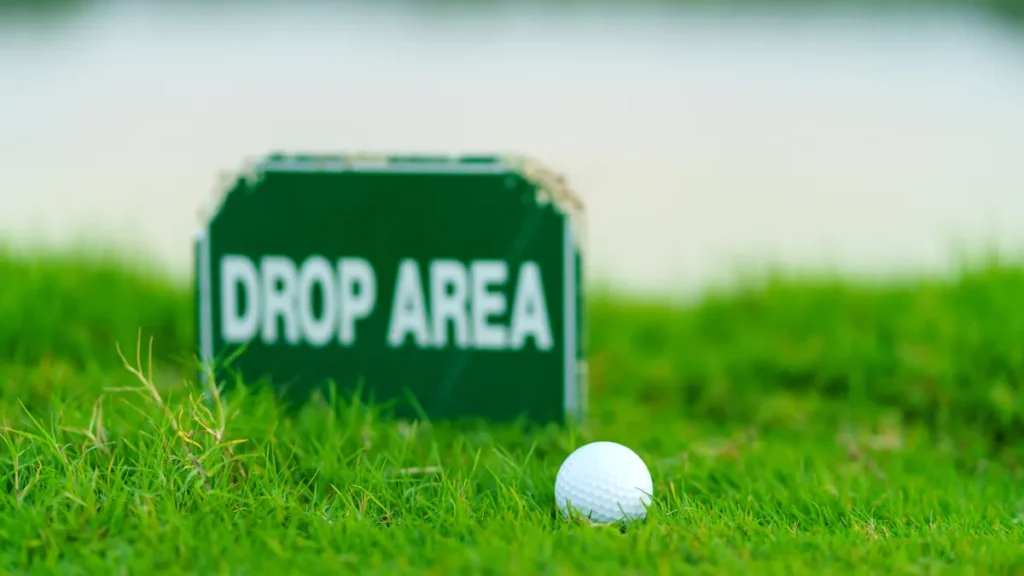
It is the player himself who drops the ball, letting it fall to knee height without bending his legs19. The ball must fall straight down, without being thrown or spun, and remain within the clearance zone4.
- If it leaves the area, we drop it once more; if it leaves again, we place it where it touched the ground on the second drop.4,19. "Club length" refers to the length of your longest club, excluding the putter20.
✅ Key takeaways
🎬 Our video lessons
🎯 What rules apply on the green?
On the green, mark the ball before picking it up; you can then clean it7. Picking up a ball without marking it costs 1 turn4.
- You can repair bullet holes, shoe marks, and old hole plugs, but not ventilation holes or natural wear and tear7. The flag may remain in the hole: there is no penalty if the ball touches it7.
✅ Key takeaways
🎬 Our video lessons
💡 Which fouls result in a two-shot penalty?
More than 14 clubs: 2 penalty strokes per hole played in violation of the rules, with a maximum of 4 penalty strokes per round6. Playing the wrong ball: 2 strokes, and you must retrieve your own ball before teeing off at the next hole, or you will be disqualified8.
- In a bunker, do not touch the sand with the club immediately in front of or behind the ball, either on the practice swing or in the backswing: 2 strokes9. Tamp down the ground behind the ball or break a branch to improve your shot: 2 strokes as well11.
🎬 Our video lessons
🛠️ Scorecard, pace of play, etiquette: what we expect from you
In stroke play, check your scorecard, have it certified by the marker, and turn it in promptly12. A score that is too high stands, while a score that is too low results in disqualification; it is not your responsibility to add up and report the handicap12.
- The Rules require players to play quickly and encourage “ready” play out of turn in stroke play, provided it is safe to do so13,8. They also expect everyone to replace their divots, rake the bunkers, and repair divots14.
✅ Key takeaways
🎬 Our video lessons
📊 Will the rules change in 2026, 2027, or 2028?
Not regarding the core of the Rules: the 2023 edition remains in effect, and the next edition will be published on January 1, 202817. The R&A has not announced a 2027 edition17.
- As of January 1, 2026, the R&A and the USGA have only added or amended Model Local Rules, which each Committee may choose to adopt or not17. Example: Local Rule G-9 on broken clubs limits replacements to filling the gap left in the bag17.
✅ Key takeaways
- These local rules apply only if the Committee adopts them17
- Always read the local rules posted in the clubhouse or on the scorecard
📚 Our Sources
| No. | Source | Document |
|---|---|---|
| 1 | The R&A (R&A/USGA Rules of Golf, 2023 edition, currently in effect) | Rule 18 – Relief for Stroke and Distance, Lost Ball or Out of Bounds, Provisional Ball (accessed on November 11, 2026) |
| 2 | The R&A (R&A/USGA Rules of Golf, 2023 edition, currently in effect) | Rule 17 – Penalty Areas (accessed on November 11, 2026) |
| 3 | The R&A (R&A/USGA Rules of Golf, 2023 edition, currently in effect) | Rule 19 – Unplayable Ball (accessed on November 11, 2026) |
| 4 | The R&A (R&A/USGA Rules of Golf, 2023 edition, currently in effect) | Rule 14 – Procedures for the Ball: Marking, Picking Up, Replacing, Dropping, and Playing from an Incorrect Spot (accessed on November 11, 2026) |
| 5 | The R&A (R&A/USGA Rules of Golf, 2023 edition, currently in effect) | Rule 16 – Relief from Abnormal Course Conditions, Embedded Ball (accessed on November 11, 2026) |
| 6 | The R&A (R&A/USGA Rules of Golf, 2023 edition, currently in effect) | Rule 4 – Player Equipment (14-club limit, measuring devices) (accessed on November 11, 2026) |
| 7 | The R&A (R&A/USGA Rules of Golf, 2023 edition, currently in effect) | Rule 13 – Greens (Marking, Repairing, Flag) (accessed on November 11, 2026) |
| 8 | The R&A (R&A/USGA Rules of Golf, 2023 edition, currently in effect) | Rule 6 – Playing a Hole (Tee Area, Wrong Ball, Order of Play) (accessed on November 11, 2026) |
| 9 | The R&A (R&A/USGA Rules of Golf, 2023 edition, currently in effect) | Rule 12 – Bunkers (accessed on November 11, 2026) |
| 10 | The R&A (R&A/USGA Rules of Golf, 2023 edition, currently in effect) | Rule 9 – Ball Played as It Lies; Ball at Rest Picked Up or Moved (accessed on November 11, 2026) |
| 11 | The R&A (R&A/USGA Rules of Golf, 2023 edition, currently in effect) | Rule 8 – Play the Course as You Find It (accessed on November 11, 2026) |
| 12 | The R&A (R&A/USGA Rules of Golf, 2023 edition, currently in effect) | Rule 3 – The Competition (Stroke Play Scorecard) (accessed on November 11, 2026) |
| 13 | The R&A (R&A/USGA Rules of Golf, 2023 edition, currently in effect) | Rule 5 – Playing the Point (Practice, Pace of Play) (accessed on November 11, 2026) |
| 14 | The R&A (R&A/USGA Rules of Golf, 2023 edition, currently in effect) | Rule 1 – The Game, Player Conduct, and the Rules (General Penalty) (accessed on November 11, 2026) |
| 15 | The R&A (R&A/USGA Rules of Golf, 2023 edition, currently in effect) | Rule 15 – Removal of Debris and Removable Obstructions (accessed on November 11, 2026) |
| 16 | The R&A | Committee Procedures, Section 8 – Model Local Rule E-5 (Alternative to Stroke and Distance) (accessed on November 11, 2026) |
| 17 | The R&A | New and Updated Model Local Rules for 2026 (published on January 14, 2026; accessed on November 11, 2026) |
| 18 | French Golf Federation (Rules Committee) | Practical Training on the Rules of Golf – Sheet No. 9: Lost Ball or Out of Bounds (accessed on November 11, 2026) |
| 19 | French Golf Federation (Rules Committee) | Practical Training on the Rules of Golf – Sheet No. 11: How to Drop the Ball (accessed on November 11, 2026) |
| 20 | French Golf Federation | Major Changes in the 2019 Edition of the Rules of Golf (Rules Committee Update, June 2020) (published in June 2020, accessed on November 11, 2026) |
❓ Frequently Asked Questions
How long do you have to search for your ball when playing golf?
You or your junior have three minutes from the moment you start searching. After that time has elapsed, the ball is considered lost: a one-stroke penalty, and play resumes from the spot of the previous shot.
What is the penalty for going out of bounds?
A penalty stroke, and you play again from the spot of the previous shot (shot and distance). If your club has adopted Local Rule E-5, you may drop near the fairway for a two-stroke penalty.
What is the difference between a yellow penalty area and a red penalty area?
The red tee offers one more option: a lateral relief two club lengths away, no closer to the hole. In either case, taking relief costs one stroke.
Can you leave the flag in the hole when using a putter?
Yes, since 2019. There is no penalty if the ball touches the flag; you just have to decide before taking the shot.
At what height should you drop the ball?
At knee height, while standing. The ball must fall straight down, touch the ground, and remain within the clearance zone.