


In match play, your total score doesn’t matter: what counts is beating your opponent hole by hole. A 9 on a hole costs you only that one hole, not an entire card. This format—the Ryder Cup—has its own vocabulary, rules, and strategy. Here are the essentials for playing—and winning—it.
What is match play in golf?
Match play pits two players—or two teams—against each other each hole. The player who finishes a hole in fewer strokes—including penalties—wins it. In the event of a tie, the hole is split. The match is won as soon as one side leads by more holes than remain to be played.
That's the big difference compared to the stroke play, the format used in professional tournaments on television, where all the strokes on the course are added up. In match play, strokes are counted only on a hole-by-hole basis, and you don’t even have to finish a hole—you can simply concede it. The scorecard is mainly used to track the status of the game.
Match Play Vocabulary
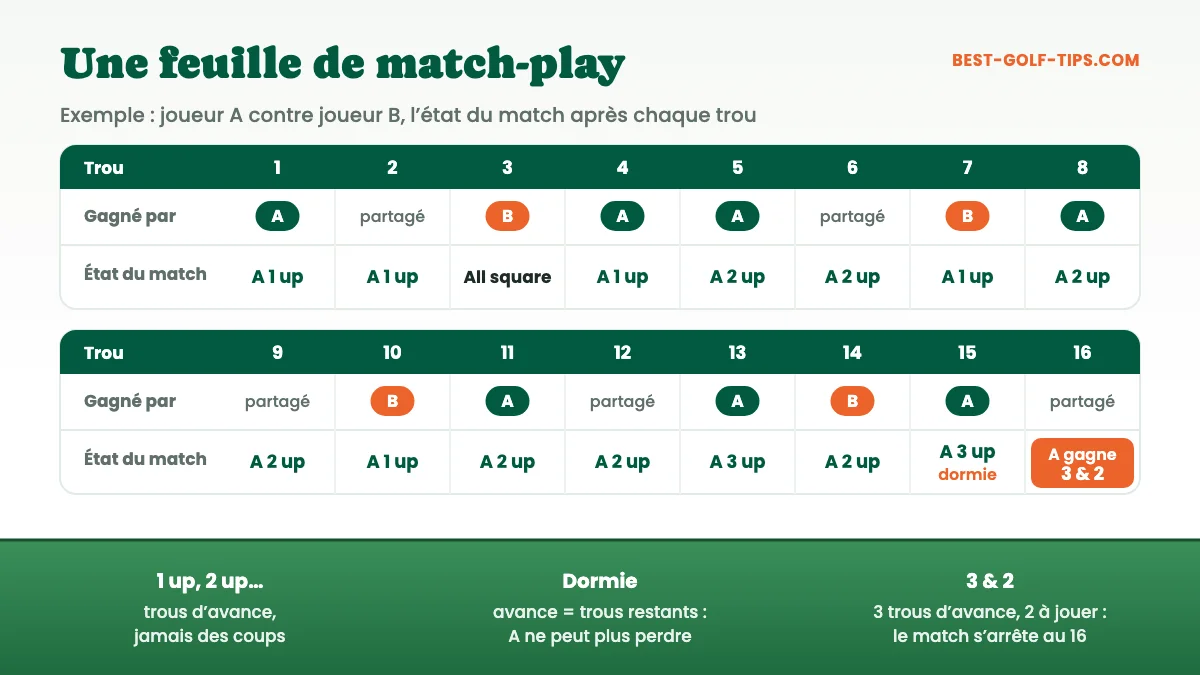
The score is expressed in holes ahead, never in strokes.
| Expression | Meaning | Example |
|---|---|---|
| 1 up, 2 up… | Be 1, 2… holes ahead | “I'm 2 up after the 9th” |
| 1 down, 2 down… | Be 1, 2… holes behind | “She's one under par at the start of the 15th.” |
| All square | Tie in the game | After the 12th, everyone had won the same number of holes |
| Asleep | The lead is equal to the number of holes remaining | 3 up with 3 holes left to play: impossible to lose over 18 holes |
| 3 & 2 | Victory by 3 holes with 2 holes remaining | The game ends at 16 |
| Shared hole | Tied on that hole | The game status remains unchanged |
A victory on the final hole is referred to as “1 up” or “2 up.” The expression all square is detailed in our definition of the all square in golf.
Rules Specific to Match Play
Concessions: The Given Putt
In match play, you can to concede your opponent their next shot, an entire hole, or even the match. The most common scenario is the given putt: The ball is a few centimeters from the hole; you say, “It’s a gift,” and your opponent picks it up, counting one more stroke. A concession must be clearly indicated, either by a word or a gesture. Once made, it cannot be refused or withdrawn. In stroke play, however, there are no concessions: every ball must be holed.
The order of play, and playing out of turn
At the start of the round, the order of play is determined by a draw or by mutual agreement. After that, the side that won the previous hole plays first; in the event of a tie, that side retains the honor. For the remainder of the hole, the player farthest from the flag plays first. If you play out of turn, there is no penalty, but Your opponent can cancel your move and have you replay it in the correct order. He'll often choose to do this if your move was excellent.
Penalties and the number of strokes
Many infractions that result in a two-stroke penalty in stroke play result in, in match play, losing the hole. Other penalties, such as a one-stroke penalty, apply in the same way under both formats. You must also tell your opponent the exact number of strokes played when asked, including penalties. For specific cases, refer to the Rules of Golf or the tournament referee. The basics are summarized on our page Golf Rules and Basics.
Tied after 18 holes
If the match is tied going into the final hole and a winner must be determined, extra holes are played until one side wins a hole. Some competitions, such as the Ryder Cup, allow for a tie, which is worth half a point to each side.
Handicap in Match Play
A handicap allows two players of different skill levels to compete on equal footing. The player with the higher handicap receives strokes, calculated based on the difference between their handicaps. These strokes are applied to the holes indicated in the “handicap” or “Hcp” column on the scorecard, which ranks the holes from the most difficult (1) to the easiest (18). On a hole where you receive a stroke, your score is reduced by one stroke to match your opponent’s score. The portion of the difference applied—particularly in foursomes and four-balls—is determined by the competition rules.
Singles, foursomes, and four-balls: the three formats
- The simple: one player against another. This is the basic form of match play.
- The Foursome: Two teams of two, with one ball per team. Partners take turns playing, and they also alternate tee times: one plays the odd-numbered holes, the other the even-numbered holes.
- Four-ball: Two teams of two; each player plays their own ball. On each hole, only the team's best score counts.
Foursome play requires trust among partners, since you’re often playing from a spot you didn’t choose. Four-ball play allows for more risk-taking: if your partner is already well-positioned, you can go for the flag.
The Ryder Cup, the most famous match play tournament
The Ryder Cup pits a European team against a U.S. team every two years, with twelve players on each side. It is played entirely in match play over three days: foursomes and four-ball on the first two days, followed by twelve singles matches on Sunday. Each match is worth one point, or half a point in the event of a tie, for a total of 28 points. A team needs 14.5 points to win; the defending champion retains the title with 14 points. France hosted the event in 2018 at Le Golf National, near Paris, and several French players competed, such as Jean Van de Velde, Thomas Levet or Victor Dubuisson. For women, the equivalent is the Solheim Cup.
What strategy should you use in match play?
Play against your opponent as much as the course
In stroke play, you play the course. In match play, the best decision also depends on your opponent’s situation. If your opponent is in the water, there’s no point in attacking a dangerous pin: a ball on the green—even far from the pin—is often enough to win the hole. If your opponent is two meters away from a birdie, you need to take more risks. The Course Management That's the basic rule; the game will tell you when to deviate from it.
Applying pressure—and handling it
The first player to tee off puts pressure on the other. A drive down the middle of the fairway or an approach shot close to the hole forces the opponent to respond. Conversely, a bad hole is just a lost hole: forget about it right away—the total score doesn’t matter. Staying calm when your opponent makes an incredible shot is a real skill, one that can be developed with The Mental Game in Golf.
Making Good Use of the Free Putt
Giving up short putts early in the match saves time and creates a friendly atmosphere. But at the decisive moment, letting your opponent have a one-meter putt to make can change the outcome of the hole. Avoid asking for a putt—it’s up to your opponent to offer it. And make sure to sink your own short putts during practice, so you don’t have to rely on their generosity.
Video Lessons to Help You Win Your Matches
 Tiger Woods' Course Management: Starting from the GreenTiger Woods · 7 min
 Céline Boutier's Course Management, from the Tee to the GreenCéline Boutier · 22 min
 The 4 Mistakes in Your Pre-Shot Routine That Cause StressPaul Lambersens · 5 min
 Viktor Hovland's putting pre-shot routine on a 10-foot puttViktor Hovland · 1 min
To work on your serve, follow the free program Master the Mental Game in 7 Steps. And to find a friendly competition near you, check out our Pro-Am Directory; the format of the game varies depending on the organizer.
For a more laid-back competition where the team's talents are combined, check out the scramble.
Frequently Asked Questions About Match Play
What does “3 & 2” mean in match play?
The winner is leading by 3 holes with only 2 left to play: the opponent can no longer catch up, so the match ends on the 16th hole.
What does it mean to be “asleep”?
This means being ahead by as many holes as there are left to play—for example, 2 up with 2 holes remaining. The player who is “dormie” cannot lose over the remaining 18 holes; at worst, the match ends all square.
Can you refuse a putt that's been given to you?
No. A concession cannot be refused or withdrawn. The ball is considered to have gone in on the next stroke, and the player may pick it up.
What happens if you play out of turn in match play?
There is no penalty, but the opponent may call the shot and ask that it be replayed in the correct order. The opponent may also allow the shot to count.