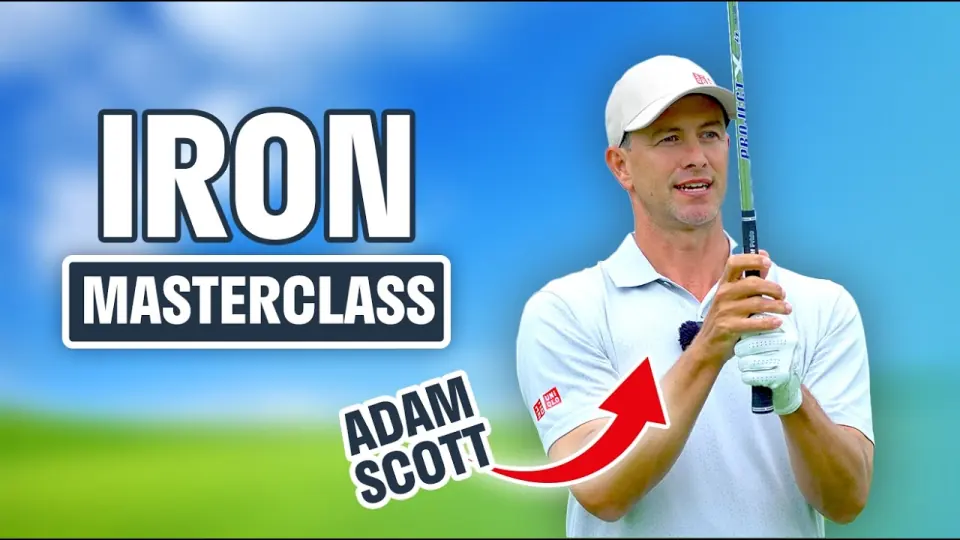

As the 2013 Masters champion, the first Australian to don the green jacket, and a former world No. 1, Adam Scott shares his swing, spin, and short game in six concise lessons.
Adam Scott is one of the most admired swings in the world of golf: winner of the 2013 Masters, the first Australian to don the green jacket, former world No. 1, and with 14 PGA Tour victories. More than twenty-five years after his debut, he’s still competing in the majors. Here’s a summary of his biography, career highlights, and video lessons.
Who is Adam Scott?
Adam Scott is an Australian golfer, born on July 16, 1980, in Adelaide. Introduced to the sport by his father, a professional golfer in Australia, he attended the University of Nevada, Las Vegas (UNLV) and turned pro in 2000. He then worked with Butch Harmon and divided his career between the PGA Tour and the European Tour. Note: This is the golfer, not the American actor of the same name.
He quickly established himself among the best: The Players Championship in 2004, the Tour Championship in 2006, and the WGC-Bridgestone Invitational in 2011. His big moment came in April 2013 at Augusta: he won the Masters on the second hole of a playoff against Argentina’s Ángel Cabrera, thanks to a birdie putt of about four meters. He became the first Australian to win the tournament. In May 2014, he rose to the No. 1 spot in the world rankings, a position he held for 11 weeks.
In 2016, the ban on anchoring the putter to the body forced him to give up the long putter he had been using for years: he adapted immediately and won the Honda Classic, followed by the WGC-Cadillac Championship. In 2020, he added the Genesis Invitational to his list of wins. His longevity is remarkable: in June 2026, the U.S. Open was his 100th consecutive major—a streak that only Jack Nicklaus had previously achieved—and in September 2026, he competed in his 12th Presidents Cup at Medinah, tying Phil Mickelson’s tournament record.
Adam Scott's Career Highlights
| Tournament or Record | Result |
|---|---|
| Major Tournament | 2013 Masters, in a playoff against Ángel Cabrera |
| PGA Tour Victories | 14, including The Players 2004, the 2006 Tour Championship, the 2011 WGC-Bridgestone, the 2016 WGC-Cadillac, and the 2020 Genesis Invitational |
| Victories on the European Tour | 11 |
| World Rankings | No. 1 in May 2014, for 11 weeks |
| Securities in Australia | 2009 Australian Open, 2012 and 2013 Australian Masters, 2013 and 2019 Australian PGA Championship |
| Presidents Cup | 12 consecutive appearances (2003–2026), a record tied |
| Longevity | 100 consecutive Grand Slam tournaments played (2026 U.S. Open) |
Adam Scott's Swing: Key Points
Adam Scott is known for having one of the most beautiful swings on tour, and its shape has barely changed in twenty years. He works with his brother-in-law Brad Malone.
- Tempo: His favourite swing thought is a slow, very deliberate backswing, because his swing tends to speed up right after the takeaway. He cites Inbee Park's tempo as his model. (GOLF.com, 2020)
- Setup and takeaway: Knees flexed, back fairly straight, arms hanging freely; arms, hands, chest and club move away together in one piece, and he does not try to 'set' the club at the top. (Australian Golf Digest, 2020)
- Coil at the top: His upper body turns well past 90° while his hips turn less than 45°, with weight on the inside of the trail heel: a very powerful coil. (Australian Golf Digest, 2024)
- Transition and impact: The downswing starts with a weight shift to the lead side while the upper body stays turned; the club comes from the inside, the lower body more open than the upper body at impact. (Australian Golf Digest, 2024)
- Ground forces: He uses ground forces very well, which still gave him a driving average close to 300 yards at 39. (GOLF.com, 2020)
- Finish: He finishes balanced on a straight lead leg, eyes on the target. For him, the worst power leak is starting down too fast from the top. (GOLF.com, 2009)
What Amateurs Can Copy from Adam Scott's Swing
- When your swing feels off, slow it down, especially the backswing, to find a steady tempo. See our rhythm and tempo lessons.
- Don't swing as hard as you can, it ruins your rhythm; and keep your address posture instead of standing up in the downswing. See our setup and posture lessons.
- Start with a one-piece takeaway and avoid turning your shoulders too early, which makes the arms lift. See our backswing lessons.
Compare with other pros' swings.
Adam Scott's Game: What His Lessons Teach Us
His lessons—most of which were filmed with English channels and condensed—show a player who simplifies everything: lots of checks before the shot, then a single thought about the swing during it.
Adam Scott's Swing and Rhythm
Adam Scott almost never watches his swing in slow motion: for him, a good rhythm makes up for a lot of flaws. He first checks his grip, ball position, and alignment, then focuses on just one thing—often the tempo—while visualizing Ernie Els or Fred Couples. Adam Scott: Rhythm, Fade, and Draw for Consistent Irons Shots. Under pressure, he reverts to a single motion: a long, slow backswing “that seems to go on forever.”. Adam Scott: A Long, Slow Backswing as a Swing Philosophy.
Draw and fade without changing your swing
To work on his shots, he doesn't change his swing: he first aligns himself with the target, then simply shifts his body and feet. This is also what he demonstrates during warm-ups, as he works his way up from the putter to the driver. Adam Scott at the Dubai driving range: warm-up, draw, and fade. At the driving range with Fred Couples, the conversation turns to ball speed, reading a tricky lie, and his low tee on the 15th hole at Augusta. Fred Couples and Adam Scott on the driving range: speed and reading the lie.
Adam Scott's Short Game
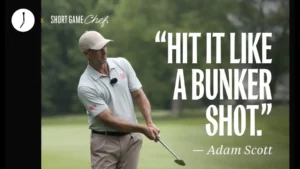
Around the green, he doesn't automatically reach for the 60° wedge: on tight lies, the 54° is more forgiving, with an early landing point and a small divot behind the ball. Adam Scott: Chipping at 54° rather than 60°. In the thick rough, he first places the club behind the ball to assess the lie, then chooses between a true bunker shot and a modified bunker shot, keeping his wrists almost still. Chipping from Thick Rough: Adam Scott's Two Rules.
Adam Scott's Best Lessons by Topic
- Short Game (wedge play, pitching, and chipping, Pitch Shots): Adam Scott: Chipping at 54° rather than 60°, Chipping from Thick Rough: Adam Scott's Two Rules.
- Irons and Shot Shapes (irons, Draw or Fade): Adam Scott: Rhythm, Fade, and Draw for Consistent Irons Shots, Adam Scott at the Dubai driving range: warm-up, draw, and fade.
- Pace and Mentality (Rhythm and Tempo, Psychology and Mental Game): Adam Scott: A Long, Slow Backswing as a Swing Philosophy.
- Practice and Warm-up (Range Practice, warm-up, Swing and Swing Plane): Fred Couples and Adam Scott on the driving range: speed and reading the lie.
See also the profile of his former coach Butch Harmon, those of Jack Nicklaus, which inspires his chips, and Phil Mickelson, his Presidents Cup rival, as well as that of Tiger Woods.
Frequently Asked Questions About Adam Scott: Career Highlights, Swing, and Golf Lessons on Video
How old is Adam Scott?
Adam Scott was born on July 16, 1980, in Adelaide, Australia; he is 46 years old.
How many majors has Adam Scott won?
One: the 2013 Masters, which he won on the second hole of a playoff against Ángel Cabrera. He is the first Australian to win the Masters.
How many tournaments has Adam Scott won on the PGA Tour?
14, including The Players in 2004, the Masters in 2013, and the Genesis Invitational in 2020, plus 11 victories on the European Tour.
Has Adam Scott ever been ranked No. 1 in the world?
Yes, starting in May 2014, for 11 weeks.
Who was Adam Scott's coach?
His father, who played professionally in Australia until he was 19, and then Butch Harmon, who advised him on his grip, among other things.
Why did Adam Scott switch putters in 2016?
Because the rules have prohibited anchoring the putter to the body since 2016. He gave up his long putter and won the Honda Classic in February 2016 using a short putter.
How many Presidents Cups has Adam Scott played in?
Twelve consecutive appearances, from 2003 to 2026 at Medinah: a tournament record, tied with Phil Mickelson.
Why is Adam Scott's swing so admired?
For its slow, steady tempo, its one-piece takeaway, its big upper-body coil and its balanced finish. Its shape has barely changed in twenty years.