

10 Steps to Try Golf for Free and Get Started
Getting started in the world of golf may seem intimidating, but it's an exciting sport that's accessible to everyone.
Whether you're looking to try a new activity, relax on the green, or take on a challenging sport, this guide is for you.
We'll walk you through the 10 essential steps—from free introductory classes to Pro-Am competitions—to help you progress.
| Steps | Tips | Estimated duration | Estimated Cost |
|---|---|---|---|
| 1. Free Introductory Session | Find a nearby golf course that offers open houses or free introductory lessons so you can try the sport with no obligation. | 1 to 2 hours | Free |
| 2. Take a “Getting Started” Course” | Take an intensive course with a professional to learn the basics quickly. | 2 to 3 days | 300 - 650 € |
| 3. Take Regular Lessons with a Pro | Alternate between individual and group lessons and practice sessions on the driving range to reinforce what you've learned. | 2 to 3 months | 50–70 € per hour |
| 4. Take the Carte Verte exam | Take the Carte Verte exam so you can play 18-hole courses on your own. | Variable | 70–100 € (exam) |
| 5. Take guided tours | Alternate between playing on your own and playing with a pro to get strategic advice on the course. | Variable | Green fee + pro's fee |
| 6. Take Advanced Training Courses | Take part in themed clinics (putting, approach shots, long game) to refine your technique. | 3 to 5 days | 150–250 € per day |
| 7. Take “hybrid” classes” | Supplement in-person classes with online courses so you can review the basics at any time. | In everyday life | Free Golf Lessons (on Best Golf Tips) |
| 8. Refine your technique | Focus on one specific aspect of your game at a time to avoid getting sidetracked. | Live | Specialized Equipment |
| 9. Participate in Pro-Am Competitions | Take part in competitions where you play on a team with a professional. | 3 to 6 full days | Variable |
| 10. Take advanced training courses | Travel to discover new routes and take intensive courses. | 3 to 7 days | 500–1,500 € (excluding airfare) |
Step 1: Get started for free at the golf course
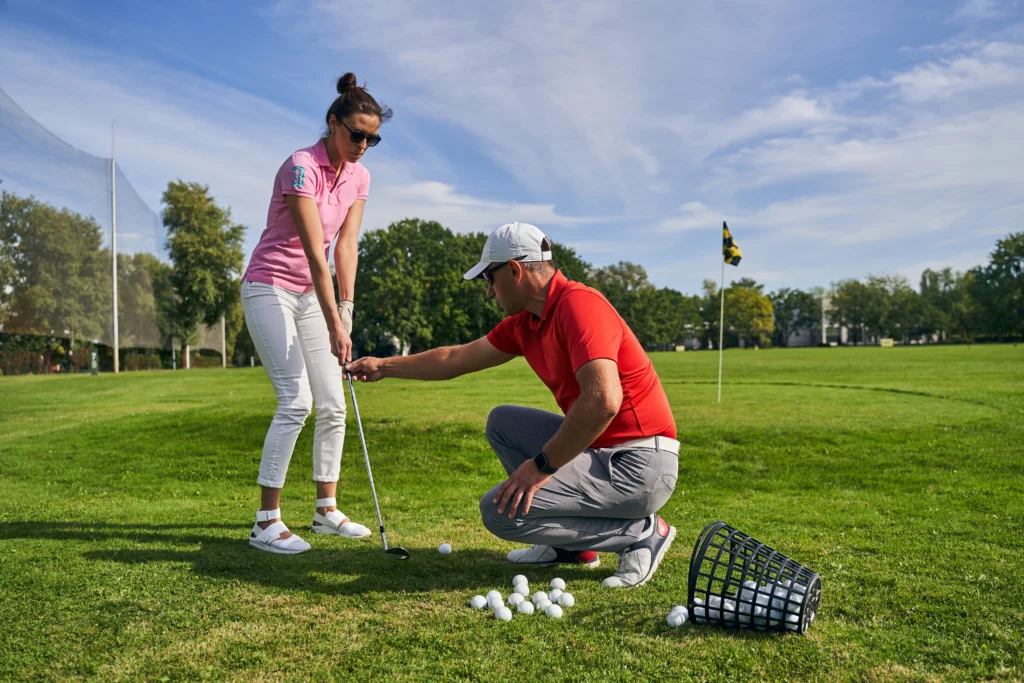
The best way to get started is to give it a try without spending any money. Many golf courses in France offer free introductory lessons for beginners.
This is the perfect opportunity to pick up a club, take your first swings, and get familiar with the surroundings.
These one- to two-hour sessions are led by a professional who will teach you the basics and answer all your questions.
CLICK HERE TO FIND A FREE INTRODUCTORY CLASS
Step 2: The introductory lesson with a golf pro
Once you're convinced, the “getting started” training course is the next step.
Typically held over a weekend, it allows you to master the fundamentals of the swing, putting, and the basic rules.
The pro will teach you the right techniques and correct you on the spot, which is essential for avoiding bad habits from the start. It’s an investment that will save you precious time.
Step 3: Take regular classes
Learning to play golf is an ongoing process.
After the workshop, it's essential to take regular lessons, whether in a group or one-on-one.
The key is to alternate between lessons with your instructor and practicing on your own at the driving range. This is your chance to repeat the movements until they become second nature.
Step 4: Take the Carte Verte Exam
The Carte Verte is your ticket to the courses.
This exam tests your knowledge of the rules and etiquette, as well as your ability to navigate a course safely. Once you’ve passed it, it grants you access to most golf courses in France.
Your golf pro will prepare you for this exam.
Step 5: Alternate between running alone and running with a partner
Real progress is made in the field.
Once you have your Carte Verte, alternate between playing on your own to get familiar with the game and playing with your pro.
He can offer you strategic advice for every game situation, helping you make the most of your progress.
Step 6: Take advanced training courses
Once you've mastered the basics, it's time to refine one aspect of your game.
Whether it's putting, chipping, or playing on the course, themed clinics will allow you to focus on specific aspects of your game. These intensive sessions are ideal for making rapid progress.
Step 7: Alternate between online and in-person classes
These days, learning to play golf isn't limited to the driving range. To supplement your training with a pro, take advantage of online resources.
Platforms like Best Golf Tips offer a wide variety of free training videos performed by professionals.
It's a great way to review concepts and learn new techniques between lessons.
Step 8: Refine Your Technique
At this point, the game is all about finesse.
Focus on one aspect of your game at a time so you don't get overwhelmed.
This could be the consistency of your drive, your approach shots, or your stance.
Equipment also plays a crucial role. Don’t hesitate to ask your pro for advice on a “fitting” to tailor your equipment to your body type and swing.
Step 9: Compete in Pro-Am Tournaments
Pro-Am tournaments give you the chance to compete against more experienced golfers and play on a team with a professional.
It’s a unique opportunity to learn how to manage stress during competition, learn proper etiquette, and get a taste of elite-level competition.
Step 10: Advanced Golf Camps Abroad
For the most passionate players, golf camps abroad offer an opportunity to improve your game in different settings, explore new courses, and enjoy a unique travel experience.
This is your chance to hone your game in the sunshine.
Frequently Asked Questions About Getting Started in Golf
Where can I find a free golf introductory class?
Many clubs open their doors several times a year, especially in the spring. Major networks such as Bluegreen or Ugolf post their schedules online. The easiest thing to do is to call the nearest golf course: many offer a free introductory hour, with clubs and balls provided.
Do I need to buy equipment to get started?
No. For the introductory class, everything is provided. When you continue, a half-series Used clubs are more than enough for the first year: a wood, two or three irons, a wedge, and a putter. Don't buy anything expensive without consulting your pro.
What should you wear to your first session?
Comfortable clothing and flat shoes are all you need: clean sneakers, neat pants or shorts, and a polo shirt or T-shirt. Avoid jeans and heels. You can find all the details in our guide at golf attire.
Is golf a sport for the rich?
That’s the most persistent misconception. Between free introductory classes, trial packages lasting a few months, used equipment, and free video lessons, you can get started for the price of a gym membership.
How long does a game last?
Allow 4 to 5 hours for an 18-hole round. Beginners often start with a 9-hole round, which takes about 2 hours, or with a compact course—shorter and easier—which is ideal for building confidence.
Do you have to be athletic to play golf?
You don't have to be an athlete. Golf mainly requires flexibility, a little stamina (you walk 6 to 8 km over 18 holes), and coordination. It's a sport that's easy on the joints and can be played at any age.
Can families or people with children get started?
Yes, and it’s actually one of the best experiences to share. Most clubs have a golf school for children as young as 5 or 6, and the compact courses make it possible for everyone to play together, regardless of skill level.
What is golf etiquette?
These are the rules of etiquette on the course: don’t talk while someone else is taking a shot, replace your divots, rake the bunker, play without delay, and shout “Ball!” if there’s a hazard. You learn these from your very first lesson; see also our page on The Rules and Basics of Golf.
What is the handicap (formerly known as the “index”)?
This is the number that measures your skill level: basically, the number of strokes you play over par. Every beginner starts with a handicap of 54 and then lowers it based on their scorecards. It allows a beginner and a skilled player to compete on equal footing. Everything is explained in our article on Calculating the handicap.
How can I make progress between lessons?
Watch the techniques in these videos. Best Golf Tips offers hundreds of free lessons from pros, organized by topic and skill level: start by Lessons for Beginners, then work on one topic at a time.
What's the hardest part when you're just starting out?
The swing requires patience, but many pros will tell you that the hardest part is mental: accepting bad shots and staying focused. The good news is that your short game around the green is what saves you the most strokes early on, and it’s also the easiest to work on.