

Updated on November 11, 2026
When it comes to drivers, the manufacturers’ rule is simple: the faster you swing, the stiffer the shaft should be. For example, Callaway recommends Regular for swing speeds of 85 to 95 mph (137 to 153 km/h), Stiff for 95 to 105 mph, and X for speeds over 105 mph.1. But other brands set their thresholds differently, sometimes with a 10 mph difference3,4,6: The table provides a starting point; the fitting provides the answer.
📌 What is flex?
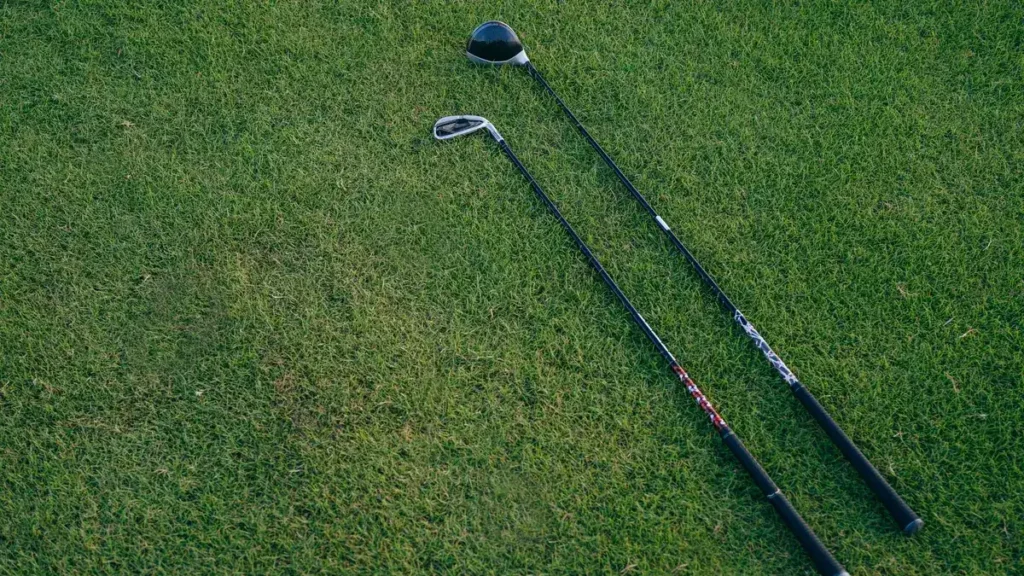
Flex refers to the stiffness of the shaft, the handle of the club. The letters range from the softest to the stiffest: L (Ladies), A (Senior), R (Regular), S (Stiff), X (Extra Stiff)1,5.
L — Ladies
The most flexible, for the slowest speeds.
A — Senior
Flexible, often recommended for seniors and those with moderate swings.
R — Regular
The standard stiffness of many commercially available drivers.
S — Stiff
Stiff, for fast swings.
X — Extra Stiff
Very steep, for very powerful hitters.
- A shaft doesn't have just one level of stiffness: Mitsubishi describes the grip, the mid-section, and the tip separately. A firm tip stabilizes the clubhead, while a more flexible tip provides better feel.7.
- Weight matters, too: Callaway offers driver shafts ranging from 40–50 g (slow swing speeds) to over 65 g (fast swing speeds)2.
🔍 The Chart: Drive Speed and Recommended Flex
Here are the thresholds published by four manufacturers for clubhead speed with a driver1,3,4,5,6.
- The ranges overlap: UST Mamiya lists the Regular at 80 to 95 mph and the Stiff at 90 to 105 mph, so both are suitable for speeds between 90 and 95 mph4.
- Mitsubishi publishes a guide based on shaft model, not a general rule. The guide for the Tensei 1K Red 2026 already recommends the Stiff for speeds between 85 and 95 mph.6.
📊 Driver swing speed → recommended flex, according to the manufacturer
| Flex | Callaway | PXG | UST Mamiya | Mitsubishi (Tensei 1K Red) |
|---|---|---|---|---|
| L (Ladies) | less than 85 mph (A or L) | less than 75 mph (Ladies or Senior) | less than 70 mph | unpublished |
| A (Senior) | less than 85 mph (A or L) | less than 75 mph (Ladies or Senior) | 70 to 85 mph | R2 or R: less than 80 mph |
| R (Regular) | 85 to 95 mph | 75 to 95 mph | 80 to 95 mph | R or S: 81 to 90 mph |
| S (Stiff) | 95 to 105 mph | 95 to 110 mph | 90 to 105 mph | S: 85 to 95 mph |
| X (Extra Stiff) | more than 105 mph | over 110 mph | more than 105 mph | No X on this model |
Sources consulted on 11/11/2026: callawaygolf.com (Driver FAQ), pxg.com (article updated on 02/29/2024), ustmamiya.com (LIN-Q PowerCore Blue and Helium NCT product sheets), Mitsubishi Chemical’s Tensei 1K Red 2026 product sheet. Mitsubishi does not publish any data beyond 95 mph for this model, which is available only in S flex.
✅ Key takeaways
- 1 mph = 1.61 km/h (95 mph ≈ 153 km/h)
- This refers to the clubhead speed with the driver, not the ball speed.
- These thresholds are starting points, not rules
⛳ Why Manufacturers Disagree
There is no standard for shaft flex: each brand defines its own R and S ratings. TaylorMade is a good example: in its 82–92 mph range, the catalog offers both R and S shafts.8.
No standard
A "Stiff" from one brand can perform like a "Regular" from another.
Tempo Matters
A fast, jerky swing puts more stress on the shaft than a fast but smooth swing.
Weight Matters
A lighter shaft helps slow shots gain speed.
The Fitting Cut
Only a launch monitor measurement can tell you which shaft is right for you.
- TaylorMade classifies its shafts based on speed, as well as on tempo (slow or fast swing) and shaft rotation during the swing8.
- Callaway notes that the standard shaft is chosen to suit the widest range of golfers and offers other custom shafts1.
📊 The 6 speed categories in the TaylorMade shaft catalog
| Average driver speed | In km/h (approx.) | Flex is mainly offered in this price range |
|---|---|---|
| less than 72 mph | less than 116 km/h | L and A |
| 72 to 81 mph | 116 to 130 km/h | A and R |
| 82 to 92 mph | 132 to 148 km/h | R and S |
| 93 to 102 mph | 150 to 164 km/h | S, then X |
| 103 to 109 mph | 166 to 175 km/h | X and S |
| 110 mph and above | 177 km/h and above | X and S |
TaylorMade, Custom Component Booklet updated on July 31, 2026 (driver and wood shafts), accessed on November 11, 2026. Best Golf Tips analysis of the catalog tables: within each category, shafts are also organized by tempo and spin.
🧭 How can you find out your swing speed?
Speed is measured using a launch monitor (TrackMan or equivalent), at a fitting center, at a driving range equipped with monitoring technology, or in a simulator. PXG measures speed using TrackMan during its fittings.3.
- Even without exact measurements, distance gives you an idea. For example, PXG and UST Mamiya associate speeds of 75 to 95 mph with a carry of about 200 to 240 yards off the driver.3,4.
- According to TrackMan, every mph gained with the driver can add up to 3 yards (2.7 m) to your distance9.
✅ Key takeaways
- Take the average of several drives, not your best one
- Take the measurement after warming up, using your own driver
- 200 yards = 183 m; 240 yards = 219 m
🎯 Signs of an ill-fitting shaft
A poor flex is never the sole cause of a bad shot. But Callaway points out that without the right flex, contact becomes less consistent, which affects direction and distance.1.
Too flexible?
The ball often flies too high and spreads widely with a fast swing: check this during a fitting.
Too steep?
Low ball flight, lack of distance, “wood” club feel: check these during a fitting.
The Right Reflex
Test two adjacent flexes with the same head and compare carry and dispersion.
- Slow speeds benefit from more flexibility, while fast speeds benefit from more stiffness to maintain optimal spin and distance2.
🎬 Our video lessons
💡 Flex, loft, and driver: it all goes together
Callaway also links loft to speed: 12° and above for speeds under 85 mph, 10.5° to 12° for speeds from 85 to 95 mph, 9° to 10.5° for speeds from 95 to 105 mph, and 8° to 9° for speeds above that2.
- A slow swing therefore often requires a more flexible, lighter shaft and a driver with a wider face. So-called "forgiving" drivers are designed with this in mind.
✅ Key takeaways
🛠️ Gain speed before changing the shaft
Your speed isn't set in stone: technique, flexibility, and strength all affect it. If it increases or decreases significantly, have your fit reassessed.
- These video lessons focus on driver clubhead speed, including for seniors.
🎬 Our video lessons
📚 Our Sources
❓ Frequently Asked Questions
What flex is best for a 90 mph drive?
Most often, a Regular shaft is recommended: this is the case with Callaway (85–95 mph) and PXG (75–95 mph). UST Mamiya recommends R or S at this speed, and Mitsubishi recommends R or S for its Tensei 1K Red. A fitting will determine the right choice.
At what speed should you switch to "Stiff" mode?
Around 95 mph (153 km/h) with Callaway and PXG drivers, starting at 90 mph with UST Mamiya, and starting at 85 mph for the Mitsubishi Tensei 1K Red. The shaft’s tempo and weight also matter.
What does "flex A" mean on a shaft?
"A" refers to the Senior flex, which falls between Ladies (L) and Regular (R). UST Mamiya recommends it for driver speeds of 70 to 85 mph.
Does a shaft that's too stiff cause a slice?
It can contribute to a low ball flight and a lack of distance, but a slice is primarily caused by the clubface and the club path. A fitting helps distinguish between these two causes.
Should the driver and irons have the same flex?
Not necessarily. Callaway measures speed with a 6-iron for its irons (Stiff: 80–90 mph; Regular: 70–80 mph) and notes that a Stiff shaft on a driver does not necessarily mean a Stiff shaft on irons.