


Between the rolling chip and the full wedge shot is the pitch: a lob shot that flies onto the green and stops quickly. This is often where amateur golfers lose the most strokes—either by hitting a fat shot into the ground or by hitting the ball past the green. Here’s what sets it apart from the chip shot, how to play it, and how to control the distance without changing your swing.
What is a pitch in golf?
A pitch is a pitch shots, typically played between 20 to 65 yards from the flag. The ball spends more time in the air than on the ground: it flies over the rough, a bunker, or a bump, lands on the green, and rolls very little. It’s played with a wedge, using a shorter swing than a full shot, and with proper body movement.
The word comes from English to pitch, “to throw.” It should not be confused with the pitch a divot—the small mark left by the ball when it lands—which is repaired with a divot repair tool. To understand where the pitch shot fits among the other shots around the green, see our definition of The Approach in Golf.
Pitch or chip: What's the difference?
Both shots are played near the green, but their logic is opposite. The chip is a short shot that rolls more than it flies: you land the ball just past the front of the green and let it roll like a putt. The pitch It flies more than it rolls: aim for a landing spot near the flag. Chipping is explained in detail in our definition of the chipping.
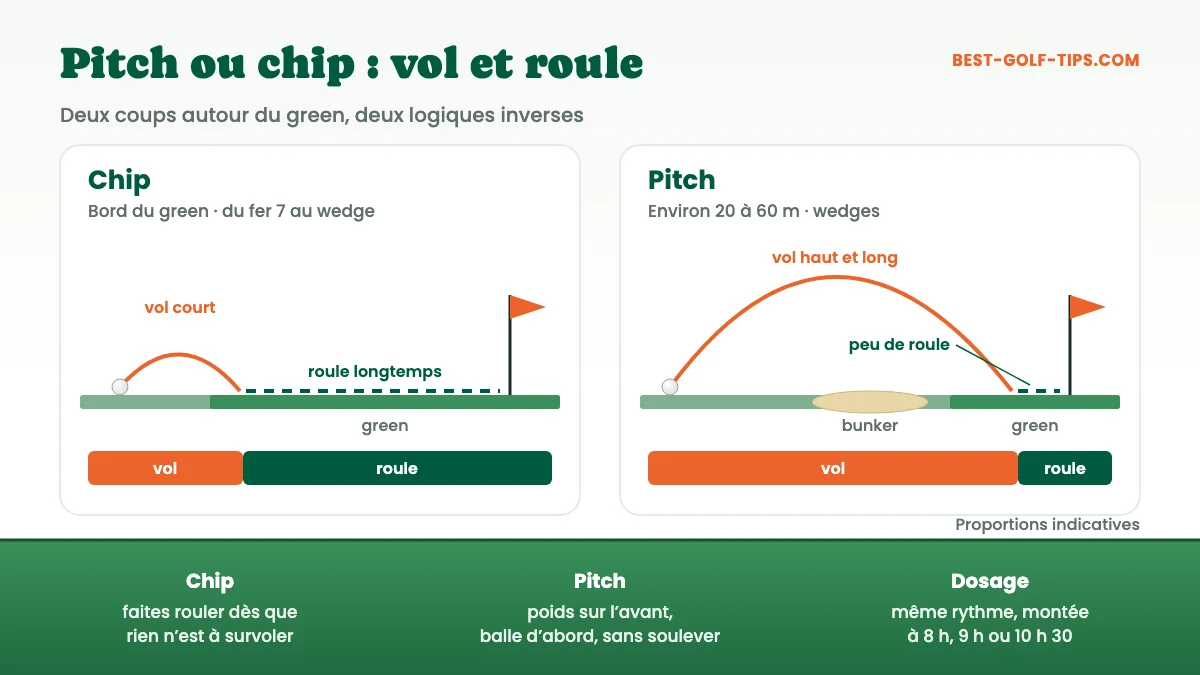
| Criterion | Chip | Pitch |
|---|---|---|
| Typical distance | Edge of the green, a few meters | About 20 to 60 m |
| Fly and Roll | More driving than flying | More flying than driving |
| Common Clubs | From the 7-iron to the wedge | Pitching wedge, gap wedge, sand wedge, lob wedge |
| Gesture | Very short, like a putt, with little wrist action | Shortened swing, coiled wrists, body rotation |
| When to Choose It | Nothing to fly over, plenty of green ahead | Obstacle to clear, flag nearby, ball to stop quickly |
The common-sense rule remains the same: Drive when you can; walk when you have to. A missed chip often ends up on the green; a missed pitch, much less so.
How to Deliver a Pitch: The Basics
The location at the address
- Slightly narrower stance a full swing, with your feet slightly turned toward the target.
- Ball in the center of the stance for the standard pitch. Lee Trevino even pulls it back a little on all his slow-motion shots, letting the clubface make up the difference in height.
- Front-end weight, about 60% on the front leg, and he keeps it steady throughout the swing. That's what places the lowest point of the swing in front of the ball.
- Hands at the level of the ball or just in front of it, never behind.
The movement: the body turns, and the arms follow
The pitch isn't just an arm swing. On the upswing, the wrists naturally cock and the shoulders rotate. On the downswing, the torso and hips continue to rotate toward the target as the club passes through the ball. The finish is short but complete: chest facing the target, weight on the front leg. For Lee Trevino, on a 35-yard pitch, it’s actually the left hip that does all the work.
Never try to lift the ball
The wedge's loft is enough to get the ball airborne. You should strike down and forward—hitting the ball first, then the ground. Any small divot will be behind the ball, never in front of it.
Measuring Distance: The Clock System
To gauge the pitch, the most reliable method is to keep the same tempo and to change only the length of the backswing. Imagine yourself in the center of a clock, as seen from the front: your left arm acts as the hand (for a right-handed person).
- Arm at 8 o'clock: a short swing, for the shortest pitches.
- Arm at 9 o'clock, parallel to the ground: the standard swing, the easiest to replicate.
- Arm at 10:30: three-quarter swing, for the longest pitches.
With three approach shots and three or four wedges, you’ll end up with a range of about ten distances. These are specific to each player: measure yours at the driving range and write them down. The follow-through should be about the same length as the backswing, and your swing speed should remain steady, without any jerks.
Which club should you choose for a pitch?
You can pitch with any wedge. The higher the loft, the higher the ball flies and the less it rolls; but the shot becomes more challenging.
- Pitching wedge (about 44 to 48°): lower trajectory, more roll. Useful for long pitches or when pitching into the wind.
- Gap wedge (about 50 to 52°): the best compromise for medium distances.
- Sand wedge (about 54 to 56°): the most versatile pitch club for most amateurs.
- Lob wedge (about 58 to 60°): a very high shot that stops abruptly, but with little margin for error.
Start with just one wedge—the sand wedge, for example—until you’re familiar with its distances. The role of each club is detailed in our definition of the wedge play.
A high, smooth pitch or a low pitch that slows you down?
Once you've mastered the standard pitch, you'll learn how to vary the pitch. Pros always have at least two in reserve.
The High and Soft Pitch
To hit a shot over a bunker toward a nearby flag, open the clubface, move the ball forward slightly, and let the club slide under it, with a short backswing and speed that builds as the club comes down. This is the method Butch Harmon learned from Phil Mickelson. Shane Lowry adds an important detail: Open the front panel to get a grip on it, otherwise your grip will close and the ball will fly low and hard. This shot requires the right lie: if the ball is buried, don't attempt it.
The low pitch that slows you down
When there's a lot of green, a lower shot is easier to control. Move the ball back slightly, lean your upper body and hands toward the target, and make contact with the ball first. Viktor Hovland even plays it this way with his 60° wedge: the ball comes out low, bounces twice, and spins. Jordan Spieth demonstrates how to play three different trajectories—low, standard, and high—while always keeping your weight forward and adjusting only the loft of the clubface. For backspin, see our definition of the backspin.
The 4 Mistakes That Ruin a Pitch
- Decelerate upon impact. That’s the number one mistake. The backswing is too long, so you brake on the downswing: you either hit the ground or hit a short shot. Shorten the backswing and accelerate hard all the way to the finish.
- To try to lift the ball. The “spoon-like” swing brings the weight back and positions the lowest point behind the ball. The result: a fat shot, or a top that rolls past the green.
- Play using only your arms. If the body stops, the hands take over and the face becomes uncontrollable. The one-handed pitch, proposed by Paul Lambersens, forces the body to turn.
- Choose the most spectacular shot. A 60° lob shot from a tight lie is a risky move. If a rolling chip or a lower pitch is possible, go for it.
Video Lessons for Successful Pitches
 Jordan Spieth's Three-Shot PitchJordan Spieth · 9 min
 A High, Soft Pitch: The Mickelson Method According to Butch HarmonButch Harmon · 3 min
 Lee Trevino's 35-yard pitch: the left hipLee Trevino · 12 min
 Viktor Hovland's low pitch that slows him downViktor Hovland · 1 min
For more information, see also Shane Lowry's high, soft pitch, Justin Thomas's backspin pitch and The One-Handed Pitch Drill. For a complete guide, follow the free program Master Your Short Game in 7 Steps, or browse all video lessons on short games.
To choose the right club based on distance and course conditions, see our guide at wedges and the sand wedge.
Frequently Asked Questions About the Pitch
From what distance do you hit a pitch?
A pitch is generally considered to be a shot between about 20 to 65 yards. Closer to the green, you'd typically play a chip; farther away, a full wedge shot.
What's the best club for pitchers?
The sand wedge is the most versatile club for most amateur golfers. The pitching wedge produces a lower shot that rolls farther, while the lob wedge produces a very high shot but is harder to control.
Why do I tweak my pitches?
Most often, this happens because your weight shifts backward as you lift the ball, or because your swing slows down at impact. Keep your weight forward, shorten the backswing, and accelerate through the finish.
How do you determine the distance of a pitch?
Keep the same rhythm and vary only the length of the swing, using a clock as a guide: arms at 8 o'clock, 9 o'clock, or 10:30. Then measure your distances on the driving range with each wedge.