


Wedges are the clubs that help you make a good score: they’re what get you close to the flag when the green is within reach. Pitching, gap, sand, or lob wedges—each has its own loft and role. Here’s how to tell them apart, what “bounce” means, how to put together your set of wedges, and which club to use for each shot.
What is a wedge in golf?
A wedge is a short iron with a very open loft, designed for precision shots: approach shots, bunker shots, and full shots from short distances. Its sloped clubface sends the ball high and imparts spin, so it stops quickly on the green. All shots played with these clubs make up what is known as the wedge play.
There are four categories, depending on the loft. The higher the loft, the higher the ball rises, the shorter the distance it travels, and the faster it stops.
PW, GW, SW, LW: The 4 wedges and Their Lofts
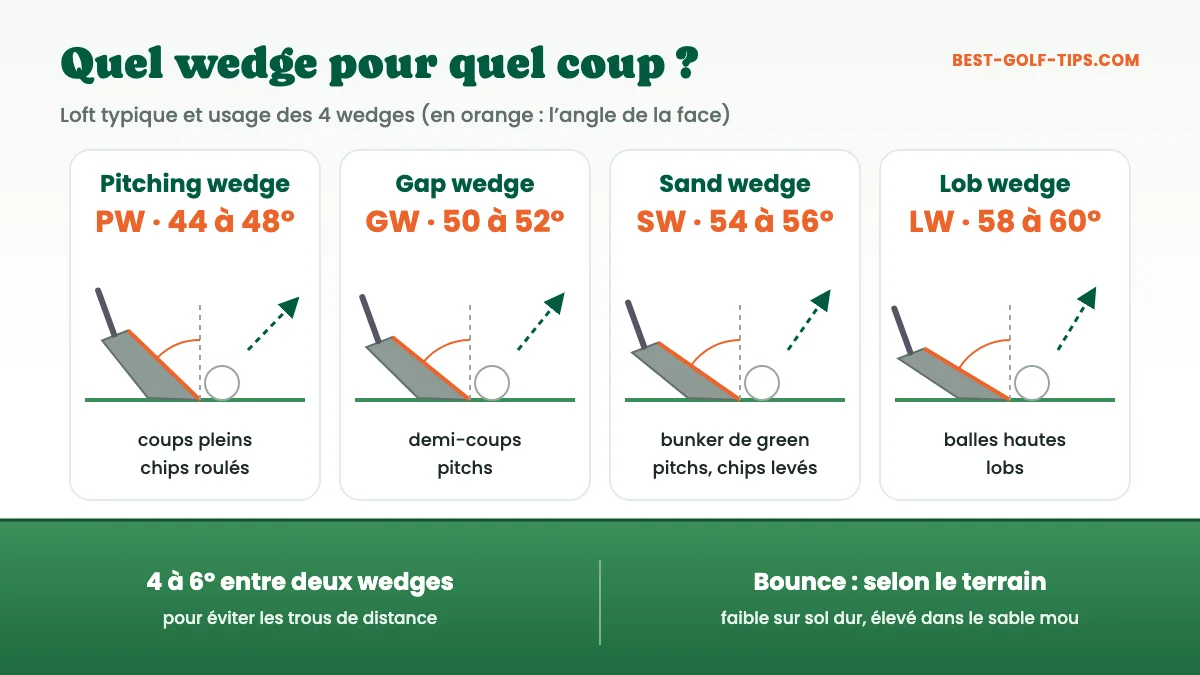
| Wedge | Typical loft | Primary Use | Approximate distance, full swing |
|---|---|---|---|
| Pitching wedge (PW) | 44 to 48° | Solid shots, rolled chips | 75 to 100 m |
| Gap wedge (GW or AW) | 50 to 52° | Full strokes and half strokes, pitches | 65 to 90 m |
| Sand wedge (SW) | 54 to 56° | Green bunkers, pitches, and high chips | 55 to 80 m |
| Lob wedge (LW) | 58 to 60° | High shots that stop quickly, lobs | 40 to 65 m |
Distances are just rough estimates for an amateur male golfer. They vary greatly depending on swing speed, ball contact, and playing conditions. The only reliable guide is your own: measure your distances at the driving range, as suggested by Raphaël Jacquelin on how to adjust his wedges.
The pitching wedge
This is the longest of the wedges and is most often sold as part of a set of irons. It is used for full shots toward the green and for chips where the ball needs to roll a long way.
The Gap Wedge
It fills “the gap” between the pitching wedge and the sand wedge. It’s also called an approach wedge (AW). Without it, the distance gap between these two clubs is often too large to be bridged by half a swing.
The sand wedge
The sand wedge is primarily a bunker club: its wide sole and bounce prevent it from sinking into the sand. It’s also a versatile club around the green.
The lob wedge
The most open of the wedges sends the ball soaring high, allowing you to clear an obstacle or attack a flag near the edge. It requires precise contact: it’s the least forgiving of the four.
Bounce and the Sole, Explained Simply
The bounce, or bounce, is the angle formed by the sole of the wedge: its leading edge is higher than the lowest point of the sole. Thanks to this angle, the club glides over the ground or through the sand instead of digging into it. Thomas Levet In his lesson, he shows how to increase it from the bunker simply by opening the clubface toward the sky.
- Low bounce (about 4 to 6°): for hard courts, tight lines, and players who slice the ball.
- Average bounce (about 7 to 10°): the most versatile, suitable for most courses.
- High bounce rate (over 10°): for soft sand, damp surfaces, and players who hit the ball hard on the way down.
The insole, which manufacturers call a “grind,” refers to the shape of the sole: material is removed from the heel, toe, or back. A cut-out sole allows you to open the face without the leading edge lifting too much. Each brand has its own terminology; just remember that a wide sole is more forgiving, and a contoured sole offers more options for a skilled player.
How do you put together your set of wedges?
Start with the loft of your pitching wedge, as indicated on the club or in the specifications for your set of irons. Then add wedges spaced 4 to 6 degrees, to avoid gaps in the sequence, such as duplicates.
- With 3 wedges: For example, PW 46°, 52°, and 58°.
- With 4 wedges: For example, PW 46°, 50°, 54°, and 58°.
Don't forget the rule limit: a maximum of 14 clubs in the bag. One more wedge often means one less wood or hybrid. For a beginner, a sand wedge in addition to the pitching wedge is more than enough to start with. A fitting helps you choose the lofts and bounce that are right for your swing and your courses.
Which wedge for which shot?
In the green bunker
The sand wedge, with a medium or high bounce, remains the go-to choice. With an open face, you strike the sand behind the ball, and the sand propels it out. If the sand is hard, compact, or shallow, a lower bounce prevents the club from bouncing off the ball.
For a rolled chip
When you have room all the way to the flag, roll the ball: use a pitching wedge or even a 9-iron. The shorter the flight, the easier it is to control the shot. Adam Scott explains why it’s better to start at 54° rather than 60°, especially with tight lees.
For a pitch
Between about 20 to 65 yards, the gap wedge and the sand wedge are the most commonly used. You control the distance by adjusting the length of your backswing, maintaining a steady rhythm.
For a lob
The flag is right behind a bunker, and there’s not much green to stop the ball on: time to use the lob wedge. Maintain your swing speed, even on a short shot. Slowing down your swing is the number one cause of failed lob shots.
Common Mistakes with Wedges
- Play every shot with the same wedge. The lob wedge isn't the right club for every chip shot. Choose the loft based on how much room you have to let the ball roll.
- Ignore the bounce. A low-bounce wedge sinks into soft sand, while a high-bounce wedge bounces off hard ground. Choose the club that best suits the type of terrain you play on most often.
- Try to lift the ball. The loft takes care of that. Hands that snap on impact cause the club to hit the ground before the ball or to top it.
- Leave spaces between the lofts. A difference of 8 or 10 degrees between two wedges forces you to hit the ball too hard or hold back on your shots.
- Play on worn or dirty grooves. The spin decreases and becomes irregular. Clean the clubface before each shot.
Video Lessons to Help You Play Your Wedges Better
 Choosing a wedge around the green: Start with the 54° wedgeAdam Scott · 14 min
 Using the Bounce Shot in ChippingAlex Fortey · 9 min
 Creating a Bounce on a Bunker ShotThomas Levet · 2 min
 100-yard wedge: 52° or 58°?Sergio Garcia · 14 min
For a complete guide, check out the free programs Master Your Short Game in 7 Steps and Escape Bunkers in 7 Steps, or browse the video lessons from short game and Bunker shot.
For the technique of the shot itself, read our article on The pitch and how it differs from the chip.
Frequently Asked Questions About Wedges
What loft should a sand wedge have?
A sand wedge typically has a loft of 54 to 56 degrees. The 56° is the most common. For bunker shots, choose a club with a medium to high bounce.
How many wedges should you have in your bag?
Usually three or four, including the pitching wedge, spaced 4 to 6 degrees apart. A beginner can start with a pitching wedge and a sand wedge.
What is the bounce of a wedge?
It is the sole angle that causes the club to glide over the ground or through the sand instead of digging in. The higher the angle, the more suitable the wedge is for soft ground and sand.
Can you hit the ball out of a bunker with a club other than a sand wedge?
Yes, the lob wedge or gap wedge work too. But the sand wedge, with its wide sole and bounce, is the most forgiving when it comes to getting the ball out of the sand.