

Updated on November 11, 2026
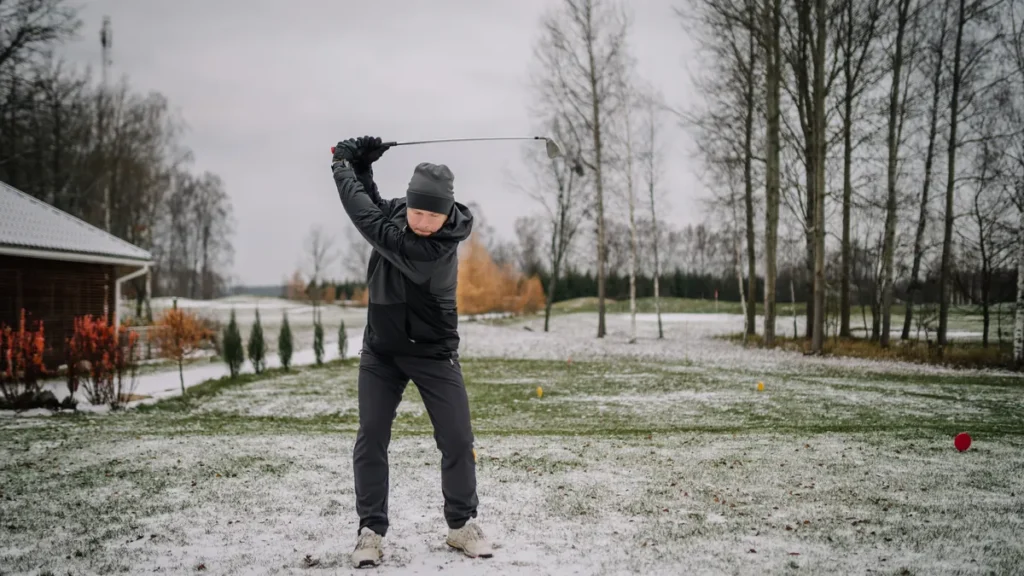
In winter, wear several layers, including a waterproof windbreaker, and keep your extremities covered6. Store your golf balls at room temperature: according to Titleist, cold air reduces distance by about 1.5% for every 20 °F (≈ 11 °C) drop in temperature1. Learn about the club's winter rules (ball placement, mats) and never walk on a frozen green2,4.
📌 What should you wear when playing golf in the winter?
The health authorities' advice is simple: wear several layers of clothing and a waterproof windbreaker6. You take one off when you warm up, and put it back on at the next checkpoint.
Close-fitting layer
A thin first layer that retains heat.
Warm layer
A sweater or a fleece—easy to take off between holes.
- Don't forget the extremities: the head, nose, and mouth6. In extremely cold weather, the same authorities recommend limiting physical activity6.
- These general guidelines are not a substitute for a doctor's advice, especially if you have a heart or respiratory condition.
✅ Key takeaways
- Choose thin layers that allow your shoulders to move freely
- Water-repellent pants for wet grass
- Waterproof shoes for soggy fairways
🔍 Which gloves should you choose when it's cold?
Winter gloves are sold in pairs—one for each hand. For example: the FootJoy WinterSof pair, with a knitted suede-like palm to maintain grip in cool weather7.
- This type of glove features a long knitted cuff and a fleece-lined back to protect against the cold7. It retails for $28 on the brand's U.S. website7.
✅ Key takeaways
- Pack a spare pair in your bag in case it rains
- Make sure the plug is secure: the grip should not rotate
- Between shots, with hands in his pockets or in mittens
🎬 Our video lessons
⛳ Do golf balls lose distance in cold weather?
Yes, for two reasons. Cold air is denser: it slows the ball down, causing it to fly a little higher and not as far1. And a cold ball loses elasticity, and therefore speed at the start1.
- Titleist provides a rough estimate: about 1.5% less distance for every 20 °F (≈ 11 °C) drop in temperature. A 200-yard (≈ 183 m) shot played at 10 °C instead of 21 °C loses about 3 yards (≈ 2.7 m).1.
- The manufacturer recommends storing the balls indoors—never in a freezing car trunk—and alternating between two balls in very cold weather, keeping the other one in a pocket1.
📊 Cold Weather and Golf Balls: What Titleist Says
| Common misconception or question | Manufacturer's Response |
|---|---|
| Does the cold make your swings shorter? | Yes: denser air and a cold ball that is less elastic1 |
| By how much? | Approximately 1.5% per 20 °F (≈ 11 °C) drop in temperature, for air alone1 |
| Should we switch to a less compressed ball? | No: When bullets are stored at room temperature, compression is no longer an issue.1 |
| Where should I store my balls? | Keep it inside all year round, not in the trunk1 |
| In very cold weather? | Use two balls alternately, keeping the second one warm in a pocket1 |
Source: Titleist Learning Lab, “Temperature and Golf Balls”1, accessed on November 11, 2026. °C and meter conversions rounded by us.
✅ Key takeaways
🎬 Our video lessons
🧭 What are the winter rules for golf?
“Winter rules” are local rules established by the club committee when course conditions are poor. They must be discontinued as soon as conditions improve.2.
- The best-known rule is the local E-3 rule regarding “preferred lies”: on the fairway, you pick up the ball, clean it, and replace it in an area designated by the club, no closer to the hole2.
- There are other rules: E-2 for cleaning the ball without moving it, E-12 for requiring the use of fairway mats when the grass is no longer growing2.
📊 The Most Common Local Winter Rules
| Model Local Regulation | What it enables | Good to Know |
|---|---|---|
| E-3 “preferred lies” | Pick up, clean, and replace the ball within a designated area, no closer to the hole | Most often on the fairway only; the ball may be repositioned only once; it is recommended to mark the ball2 |
| E-2: Cleaning the ball | Pick up and clean the ball, then put it back in the same spot | Marking the ball is required2 |
| E-12 fairway mat | The committee requires players to play from a stack | On all fairways or just some of them2 |
Source: The R&A, “2025/2026 Winter Rules FAQs,” published on December 5, 20252, accessed on November 11, 2026. The size of the area is determined by each club.
✅ Key takeaways
🎬 Our video lessons
🎯 Why are the greens closed when it freezes?
When it freezes, ice crystals form in the grass, making it brittle. Walking or driving over it can break the cells and kill the grass.4.
Frost at the start?
The course may remain closed as long as there is frost in areas that cannot be avoided4.
Before You Go
Call the front desk: frost lasts longer in low-lying areas and on north-facing slopes4.
- The damage isn't always visible right away, and the grass may take more than a month to recover4. The greens are the most exposed: a foursome walks 300 steps or more there4.
- Many clubs then open temporary winter greens. This prevents almost any damage to the actual greens while still allowing play to continue5.
🎬 Our video lessons
💡 How can you adjust your game in cold weather?
Cold weather makes your shots shorter: use a longer club than usual1. On hard or soggy ground, it's often better to play a rolled shot rather than a lifted shot around the greens.
- Take the time to warm up: cold muscles don't perform as well. In winter winds, aim lower and use a gentler swing.
✅ Key takeaways
- The cold makes the strokes shorter1: yet another club
- A gradual warm-up before the first start
- A low shot into the wind, a chip shot rolled near the green
🎬 Our video lessons
🛠️ Maintenance: Protecting Your Equipment and the Course in Winter
Store the balls indoors at room temperature, and let them warm up gradually if they've gotten cold.1.
Clean Clubs
Grooves cleaned and grips dried after each game.
Pitches and divots
We smooth out the pitches and fill in the holes, especially in winter.
- While on the course, please respect the closed areas and the rules for golf carts: driving on frozen grass damages it just as much as walking on it4.
- Clean your clubs and balls after your round: mud in the grooves reduces spin.
🎬 Our video lessons
📊 What if it's too cold to go outside?
When the course is closed, winter is still a good time to practice at home: swing rhythm, putting, and ball contact.
- Just a few minutes a day are enough to stay in shape until spring.
🎬 Our video lessons
📚 Our Sources
| No. | Source | Document |
|---|---|---|
| 1 | Titleist (manufacturer, Learning Lab) | Temperature and Golf Balls (accessed on November 11, 2026) |
| 2 | The R&A | The R&A 2025/2026 Winter Rules FAQs (published on December 5, 2025; accessed on November 11, 2026) |
| 3 | The R&A | Rules of Golf, Rule 4 – Player’s Equipment (4.2a) (accessed on November 11, 2026) |
| 4 | USGA | Frost Delays – What Every Golfer Should Know (George Waters) (published on October 27, 2025; accessed on November 11, 2026) |
| 5 | USGA Green Section Record | How Much Damage Can Winter Cause to Greens? (Adam Moeller) (published on January 20, 2023; accessed on November 11, 2026) |
| 6 | Sante.fr (Ministry of Health; recommendations approved by the HCSP and Santé publique France) | What precautions should you take during a cold snap? (published on July 23, 2025; accessed on November 11, 2026) |
| 7 | FootJoy (manufacturer) | WinterSof Pair – Men's Golf Gloves ($28 price recorded on 11/11/2026 on the U.S. website) |
❓ Frequently Asked Questions
What should you wear when playing golf in the winter?
Wear several thin layers, add a waterproof windbreaker, and cover your head, neck, and hands. Remove a layer as you warm up.
Does a golf ball travel a shorter distance when it's cold?
Yes. According to Titleist, cold air alone causes a loss of about 1.5% in distance for every 11 °C drop in temperature, and a cold ball also loses a little speed.
Do you need a special ball for winter?
Titleist says no: if your balls are stored at room temperature, compression is no longer an issue, and it’s best to stick with your usual model.
What is the winter rule in golf?
This is a local rule established by the club, often known as “preferred lies” (E-3): on the fairway, you may pick up, clean, and replace your ball within a small area, provided it is no closer to the hole.
Can you play on a frozen green?
You should not walk on a frost-covered green: the frozen grass breaks and may die. Golf clubs either close the course or open temporary winter greens.